Ground Mount Solar Panel Cost 2026
If your roof is shaded, aging, or simply too small, your yard may be the best place for solar. But ground mount solar panel cost runs higher than rooftop pricing, and you should know the real numbers before you call an installer. Most homeowners pay about $2.80 to $4.00 per watt installed for a standard fixed tilt ground array. EnergySage puts the average ground system at $43,571 for 14.7 kW, which works out to $2.96 per watt.
If the ground is not an option for your property, compare against the rooftop route in our solar panel installation cost guide, which breaks down what a standard roof array runs per watt installed in 2026.
That figure is the full gross price before any incentive, and that distinction matters more than ever in 2026. The federal solar tax credit has ended for homeowner owned systems, so the ground mount solar panel cost in a quote is basically the cost you pay, minus any state or utility help. Later in this guide we break down exactly where the money goes, line by line.
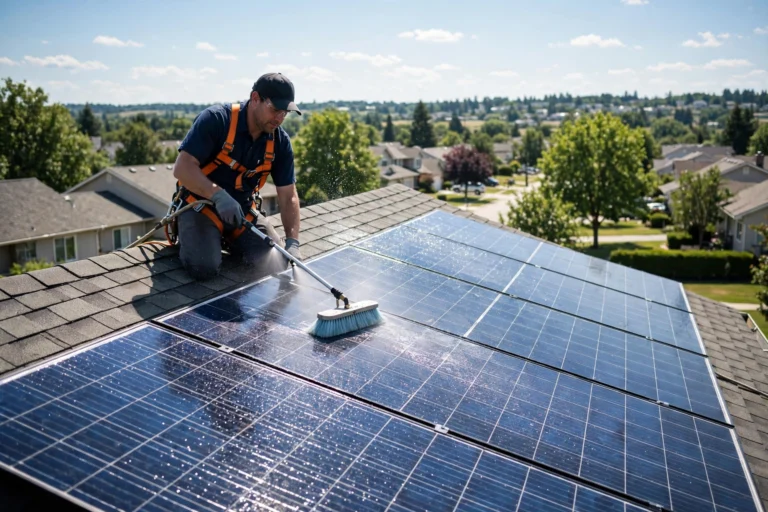
One ownership advantage to keep in mind while you compare: panels you can reach from the ground are far easier to keep clean than panels on a steep roof. Our solar panel cleaning cost guide shows what professional cleaning runs if you would rather hire it out.
One more thing before the numbers. Ground mount solar panel cost varies more from quote to quote than rooftop pricing does, because site work is involved. Soil, slope, and the distance to your electrical panel all move the total, sometimes by thousands of dollars. Always get at least 3 local quotes, and make each installer price the same system size so you can compare them fairly.
How Much Does Ground Mounted Solar Cost?
So how much does ground mounted solar cost for a typical home? The short answer is that most residential projects land between about $25,000 and $60,000 gross, depending on size. The table below uses the $2.80 to $4.00 per watt range and published 2026 pricing anchors.
| System size | Typical total cost (gross) | Notes |
|---|---|---|
| 5 kW | $14,000 to $20,000 | Small systems carry the highest cost per watt |
| 10 kW | $28,000 to $40,000 | One installer comparison puts well priced jobs at $26,000 to $34,000 |
| 14.7 kW | About $43,571 | EnergySage 2026 average ground system |
| 15 kW | $42,000 to $60,000 | Premium installer quotes can reach about $55,885 |
| 20 kW | $56,000 to $80,000 | Larger arrays trend toward $3.44 per watt or less |
Bigger systems cost more overall but less per watt, because design, permitting, and crew setup spread across more panels. A small 5 kW ground mount carries the worst per watt economics of the range, which is worth knowing if an installer pushes you toward a tiny array. Keep that in mind when you compare ground mount solar panel cost across sizes, because a per watt figure from a 20 kW quote will never match one from a 6 kW quote.
You will also find quotes sitting well above these bands. One national installer, for example, quotes about $27,480 gross for a 5 kW ground system, far above the roughly $14,800 that the EnergySage average implies for that size. Treat numbers like that as high outliers, not the market. Your ground mount solar panel cost should land inside the table range unless your site is genuinely difficult.
Finally, check what a quote includes. Ground mount solar panel cost should cover panels, inverter, racking, footings, trenching, wiring, permits, and labor. It usually does not include a battery, an electrical panel upgrade, or tree work, so confirm those items line by line in every bid.
Ground Mount vs Roof Mount Solar Cost
The ground mount vs roof mount solar cost comparison has two answers, and installers tend to quote whichever one suits them. In total dollars, ground systems cost about 41% more than rooftop systems, according to EnergySage. That headline sounds brutal, but it is partly a size effect, since ground arrays average 14.7 kW while rooftop systems average closer to 12 kW.
Per watt, the gap shrinks a lot. EnergySage puts ground mount solar panel cost at $2.96 per watt against $2.60 per watt for rooftop, a difference of about 12%. On a matched 10 kW system, expect to pay roughly $4,000 to $6,000 more to put the panels on the ground instead of the roof.
There is a production offset, too. A ground array can face true south at the ideal tilt with no shade compromises, so it typically makes about 5 to 15% more electricity than a compromised roof, and up to about 25% more in the best comparisons. That extra output claws back part of the premium over the life of the system. When you weigh ground mount solar panel cost against rooftop cost, weigh the extra production as well.
Where the Extra Money Goes
Ground mount solar panel cost is not one big markup. It is a stack of real line items that a rooftop install simply does not need. The figures below come from an installer comparison for a 10 kW system in early 2026, and they show the pattern clearly.
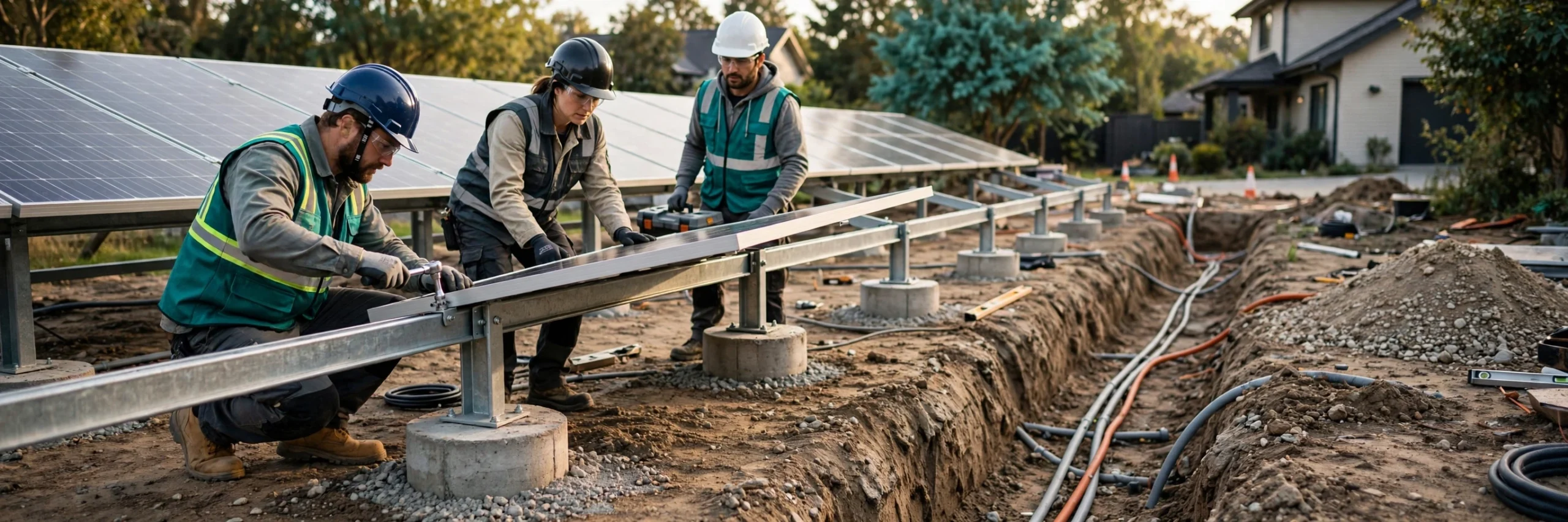
Start with ground mount solar racking cost, the galvanized steel structure that holds the panels. Racking runs $4,000 to $6,000 on a 10 kW ground system, versus $2,000 to $3,000 for roof rails and mounts. Under the racking, concrete footings or other foundations add $1,500 to $3,500. A roof never has that cost, because the house itself is the structure.
Then comes the trench. Digging, conduit, and wire from the array to your panel add $1,500 to $3,000 for a typical distance. Labor also runs higher, roughly $1,000 to $1,500 more than the same system on a roof, because the crew is building a small structure in your yard, not just bolting rails to rafters. None of this is padding. It is the physical site work that ground mount solar panel cost has to cover.
What does not change is the solar equipment itself. Panels and the inverter run $10,000 to $12,000 on a 10 kW system whether they end up on your roof or in your yard. When you compare ground mount solar panel cost quotes, the equipment lines should look nearly identical, and the site work lines are where honest quotes separate from padded ones.
Pole Mounts and Tracking
A standard ground array sits on a fixed rack, but it is not your only option. Pole mount solar panel cost runs about 15 to 35% above a standard ground mount, because a single heavy pole and a deep foundation carry the whole array. Pole mounts suit small arrays, tight spaces, and yards where you want the ground underneath left open for mowing or parking.
Tracking mounts follow the sun across the sky. Single axis tracking adds about $0.50 to $1.00 per watt to your ground mount solar panel cost, and dual axis tracking adds about $1.00 to $2.00 per watt. In exchange, trackers can raise production by 25% or more, and single axis systems can gain up to about 35% in strong sun regions.
Tracking pays best where land is limited but sunshine is strong, because more output per panel means fewer panels to buy. It pays worst in snowy or windy regions, where moving parts need more maintenance and pole mounts handle heavy snow loads poorly. For most homes, fixed tilt keeps ground mount solar panel cost lowest and the system simplest, with nothing to service but the array itself.
Site Factors That Move Your Quote
Two neighbors can get very different ground mount solar panel cost quotes for the exact same system size. The difference is almost always under the ground, or in the distance between the array and the house.
Distance is the biggest variable. Trenching alone runs about $4 to $12 per linear foot, conduit adds roughly $4 to $8 per foot, and a finished underground electrical run lands around $10 to $30 per foot with labor and wire included. An array placed 150 feet from your panel can add thousands over one placed 40 feet away, and very long runs may need thicker wire to limit voltage drop. That is why good installers measure the run before they lock in a ground mount solar panel cost.
Soil and slope come next. Rocky ground rules out cheap driven piles and pushes the design toward drilled concrete piers, ground screws at $100 to $250 per point, or ballasted bases at $200 to $400 per point. A sloped site may need grading or stepped racking, plus extra engineering. Level, clear, soft soil is the cheap case every installer hopes for.
Rules add cost as well. Many towns require a fence around a ground array because the wiring sits at ground level, and zoning may impose property line setbacks, height caps, front yard bans, or lot coverage limits. Ground mounts often need stamped engineering drawings, and permit timelines run from a few weeks in easy jurisdictions to several months in strict ones. Ask about all of this up front, because ground mount solar panel cost quotes sometimes leave fencing and permit fees out.

When Ground Mount Wins (and When It Does Not)
Ground mount wins when your roof is the problem. If the roof is shaded, chopped up with dormers, north facing, or covered in slate or tile, a sunny yard beats it easily. Ground mount also wins when your roof is within a few years of replacement, because panels on the ground never need an expensive removal and reinstall when the shingles get redone. If the roof needs thousands of dollars in repairs before panels can go up, the higher ground mount solar panel cost can still be the cheaper path overall.
It also wins on production and upkeep. You can set the perfect tilt and a true south orientation, expand the array later if your needs grow, and clean or inspect everything from the ground with no ladders and no roof walking. There are no roof penetrations, so there is no leak risk, and your roof warranty stays untouched.
It loses when land or money is tight. A 10 kW array needs roughly 600 to 800 square feet of open, unshaded yard, and that is land you may not want to give up. Rooftop solar is about 12% cheaper per watt, and ground mount solar panel cost also buys you ground level exposure to lawn equipment, wildlife, and vandalism. Some HOAs and zoning boards restrict height or placement, which can shrink a design or block it outright.
Incentives in 2026: Read This Before You Budget
Here is the change that trips up the most shoppers this year. The federal Section 25D tax credit, the old 30% credit you will still see advertised everywhere, is worth $0 for homeowner owned systems installed in 2026. It ended for systems placed in service after December 31, 2025. Any quote that subtracts 30% for a federal credit is selling you a number you cannot claim.
So budget on the gross ground mount solar panel cost, and treat state and utility programs as the remaining help. New York’s NY-Sun program offers a rebate worth up to about $5,000 depending on your utility territory. Illinois Shines pays for renewable energy credits over 15 years, Massachusetts SMART 3.0 pays per kilowatt hour produced for 20 years, and New Jersey’s SREC-II program pays about $77 to $90 per megawatt hour for 15 years.
Programs differ by state, utility, and income level, and ground systems qualify on the same terms as rooftop in the states above. Before you finalize a budget, search the DSIRE database of state incentives for everything your address qualifies for, and skim the Department of Energy solar resources for current federal guidance. With ground mount solar panel cost this high, a missed rebate is real money left on the table.
Frequently Asked Questions
How much does a ground mounted solar system cost in 2026?
Ground mount solar panel cost averages about $43,571 before incentives for a 14.7 kW system, or $2.96 per watt, according to EnergySage. Most homes pay roughly $2.80 to $4.00 per watt installed, so a 10 kW system runs about $28,000 to $40,000 gross.
Why is ground mount solar panel cost higher than rooftop cost?
Because you are building a structure your roof normally provides for free. On a 10 kW system, racking runs $4,000 to $6,000, footings add $1,500 to $3,500, the trenched wiring run adds $1,500 to $3,000, and labor runs higher. That works out to about 41% more in total, or roughly 12% more per watt.
Is there still a federal tax credit for ground mount solar in 2026?
No. The 30% Section 25D credit ended for homeowner owned systems installed after December 31, 2025, so budget on the gross price. State programs such as NY-Sun, Illinois Shines, and Massachusetts SMART still pay, and leased systems may still carry credit value that the owning company passes through in the monthly price.
How much land does a ground mount system need?
Plan on about 100 square feet per kW once setbacks and access are included, so roughly 600 to 800 square feet for a 10 kW system. The spot also needs to stay unshaded through the middle of the day, which is why a site visit matters before anyone quotes you a firm price.
Do ground mounted panels produce more electricity than rooftop panels?
Usually, yes, when the roof is not ideal. Setting true south at the perfect tilt gains about 5 to 15% over a compromised roof, and adding tracking raises output by 25% or more. Against a perfect south facing roof, though, the production gap is small, so the premium has to be justified by the roof’s problems.
How long does a ground mount system last, and what maintenance does it need?
Panels are built for 25 years or more, and galvanized steel racking typically lasts 25 to 30 years. Maintenance is simple: keep grass and weeds under the array trimmed so nothing shades the bottom row, hose and brush the panels from the ground when they get dirty, brush off snow in winter, and check bolts and coatings after major storms.