Lead Paint Removal Cost 2026
If your house was built before 1978, some of its paint probably contains lead, and that changes the math on any repaint. The lead paint removal cost is not a regular paint price with a small markup. For a typical limited-scope project in 2026, homeowners pay $1,478 to $5,520, with an average of about $3,499. Priced by area, the work runs $6 to $17 per square foot. Knowing what a fair lead paint removal cost looks like prevents expensive surprises.
Old painted walls often hide another layer underneath: wallpaper. If your project starts by stripping paper off suspect walls, our guide to wallpaper removal cost covers what that prep step runs and how it is priced per square foot.
One warning first: that average covers a room, a few windows, or a few components, not an entire house. Scope is everything with this kind of work. A single bedroom with proper containment is a predictable job. A whole-house lead paint abatement cost sits in a different category entirely, usually $10,000 to $30,000. Comparing a one-room lead paint removal cost with a whole-house abatement quote is a common mistake, so the first step is knowing which project you actually have.
Once the lead work is done and the clearance test passes, the rooms still need fresh paint. Our interior house painting cost guide shows what a standard repaint runs per room and per square foot, so you can budget the full project end to end.
There is also a legal layer most paint jobs never deal with. On a pre-1978 home, federal rules require an EPA-certified firm using lead-safe methods. That requirement is built into every legitimate lead paint removal cost you will be quoted, and it explains much of the gap versus an ordinary repaint. Below: pricing by scope and square foot, the testing to order first, and when sealing the paint in place is the smarter, legal answer.
How Much Does Lead Paint Removal Cost?
So, how much does lead paint removal cost once the price is matched to the scope? Small jobs price like a premium paint project; large ones like a construction project. The table below shows the scopes contractors quote most often.
| Project scope | Typical cost |
|---|---|
| Window or door frame, per opening | $400 to $1,500 |
| Single room with containment | $1,500 to $4,000 |
| Medium home, most painted surfaces | $7,000 to $14,000 |
| Whole-house abatement, 2,000 sq ft home | $10,000 to $30,000 |
Labor is the largest part of the lead paint removal cost, and it is not painting labor. Crews set up plastic containment, work wet to keep dust down, vacuum with HEPA equipment, and bag everything they remove as hazardous waste. Those hours are why a lead job runs several times the price of the repaint that follows it, and why two homes the same size can carry a very different lead paint removal cost.
Budget for the tail of the job, too: cleanup, disposal, dust testing, and surface repairs can add $300 to $5,000 on top of removal itself. Ask whether those items are inside the quote or billed later, because that is where similar-looking bids stop being similar.
Lead Paint Removal Cost Per Square Foot
Quoted by area, the lead paint removal cost per square foot runs $6 to $17 for most projects. Full removal sits at the top of that band: Fixr and Angi both put complete removal at $8 to $17 per square foot, and HomeGuide puts removal at $10 to $17.
So what does the lead paint removal cost actually buy at that rate? Six-mil plastic containment around the work area, negative-air machines or HEPA vacuums, wet scraping and sanding methods that keep dust out of the air, and sealed disposal of everything removed. Disposal alone can run $400 to $1,200 per 55-gallon drum of lead waste. None of that exists in a normal paint quote.
Per-foot pricing breaks down on small jobs: a contractor cannot set up containment for one window at a square-foot rate, so small components are priced per opening instead, $400 to $1,500 for a window or door frame. If your lead paint removal cost quote for a small job looks high per foot, the setup is usually the reason.
Methods Compared: Removal, Encapsulation, Enclosure
Removal is not the only legal way to deal with lead paint, and not always the smartest. The right method depends on the surface, its condition, and whether hands or sashes rub against it daily. Comparing lead paint encapsulation vs removal cost side by side is the quickest way to see where the money goes. On most small jobs, the method decision moves the lead paint removal cost more than the size of the room does.
Chemical stripping is the gentlest full-removal method. Paste strippers soften paint so it scrapes off wet. Expect $4 to $8 per square foot on wood, metal, and masonry, and $8 to $16 on porous surfaces. It is slow work, which is why pros save it for detailed trim and historic woodwork.
Wet scraping and wet sanding are the workhorse methods. Crews mist surfaces before and during work so dust never gets airborne, and power sanding must run through a shroud connected to a HEPA vacuum. Heat is tightly limited: heat guns may never run above 1,100°F, because past that point lead vaporizes into fumes that settle as ultra-fine dust. Open-flame burning is banned outright. A quote that involves torches or dry power sanding should be rejected on the spot.
Encapsulation seals lead paint under a thick, flexible specialty coating instead of removing it. Pricing has two scopes: coating and prep alone can run $1 to $4 per square foot (Fixr), while a professionally applied job runs $6 to $10 (Angi and HomeGuide). That is the lead paint encapsulation vs removal cost trade: less money now, but the lead stays, so the coating needs monitoring over its roughly 10 to 20 year life. Encapsulation is not allowed on peeling paint or on friction surfaces like window sashes and door jambs.
Enclosure covers the surface with a rigid barrier, new drywall, paneling, or aluminum capping, at $6 to $12 per square foot (Fixr) or $8 to $13 (HomeGuide). It is more durable than encapsulation and common on siding and jambs. Replacement removes the component entirely. For windows, replacement at $300 to $1,000 per window often beats $400 to $1,500 per opening to strip the old frame, and it deletes the friction surface for good.
First Step: Testing
Do not pay for removal before you know where lead actually is. A cheap swab kit, $5 to $30 at a hardware store, can screen one surface, but it is not proof. Most homeowners need a professional lead inspection with an XRF scanner, which reads lead through paint without damaging it. A typical XRF inspection runs $300 to $600, with a broad range of $250 to $850 by house size. Testing routinely saves thousands, because you only treat surfaces that test positive.
An inspection and a risk assessment answer different questions. The inspection maps lead paint surface by surface. A risk assessment, at $500 to $700 or more, goes further: it adds dust-wipe samples, soil samples, and a condition check, so it tells you where lead is a hazard right now, not just where it exists. If you are buying, renovating, or have a child under six, the risk assessment is usually the better spend, and it keeps your lead paint removal cost focused on surfaces that are actually hazardous.
The RRP Rule: Why You Cannot Just Hire Anyone
Since 2010, the EPA Renovation, Repair, and Painting Rule has governed this work. Any firm paid to disturb lead paint in housing built before 1978 must be an EPA Lead-Safe Certified Firm, and each job must be run by a Certified Renovator. The rule kicks in when work disturbs more than 6 square feet of painted surface per room inside, or more than 20 square feet outside. Window replacement triggers it at any size. The full requirements are set out in the EPA Renovation, Repair, and Painting Program.
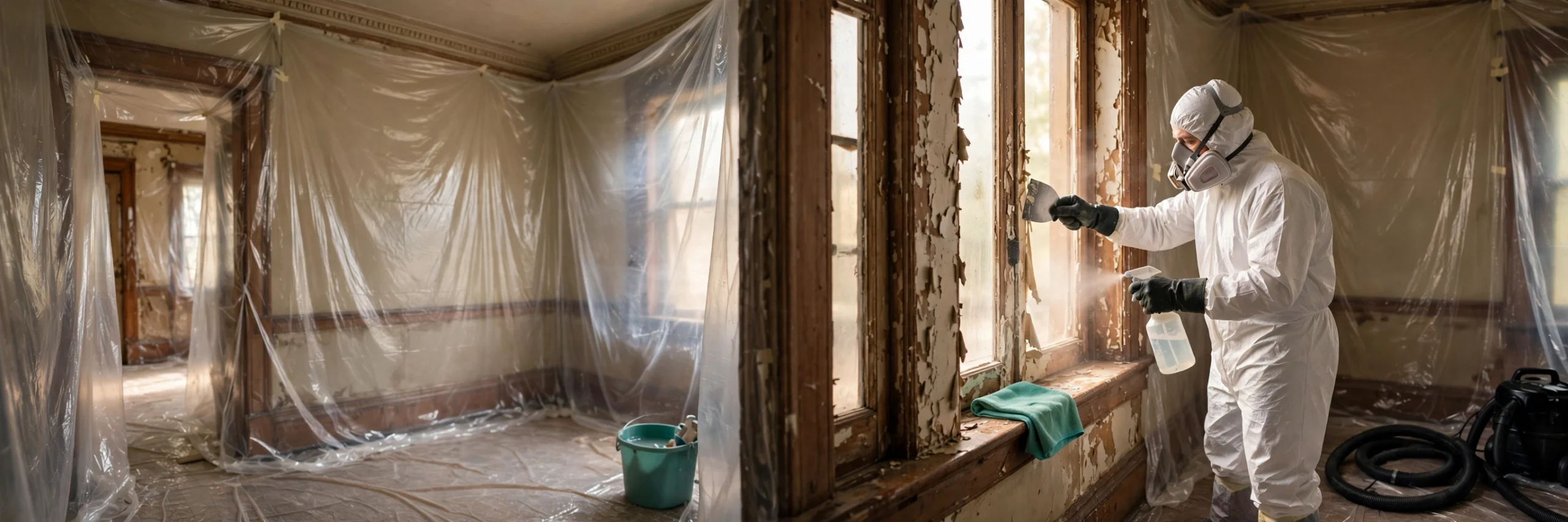
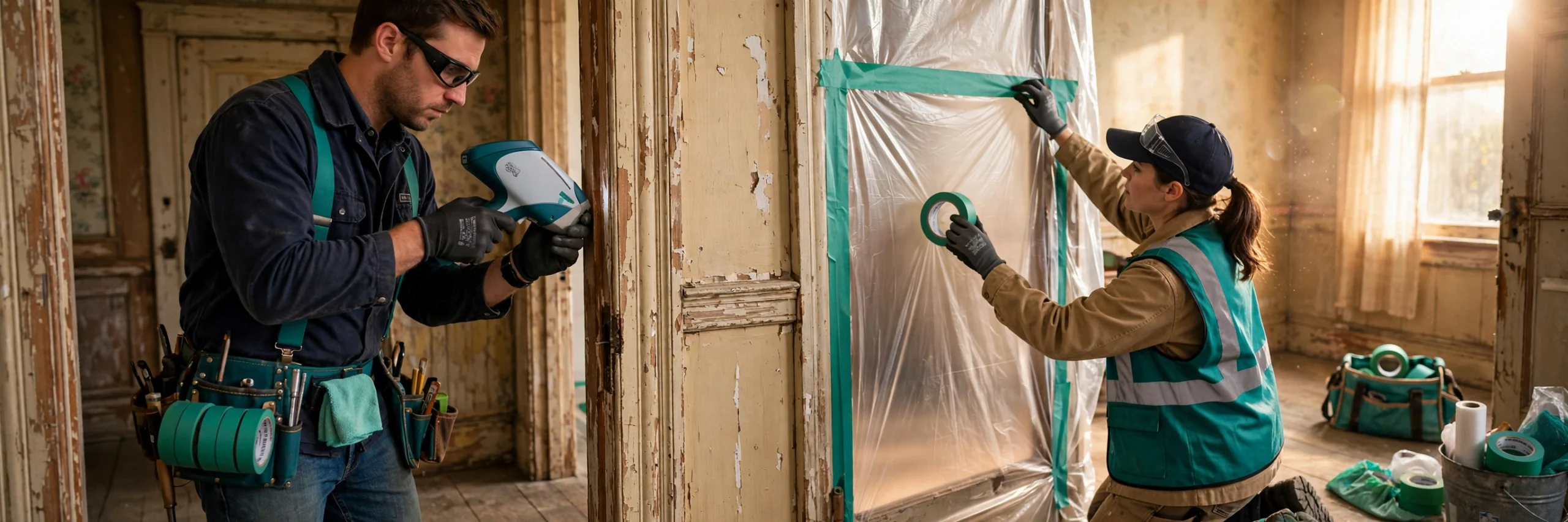
In practice, the crew seals the work area in plastic, posts warning signs, hands you the EPA pamphlet before starting, uses wet methods and HEPA vacuums, and finishes with a documented cleaning verification. Records are kept for three years. The EPA lead paint guidance for homeowners is worth reading before you sign anything, because it shows exactly what a compliant crew should do in your house.
All of that shows up in the quote. Compliance typically adds about $600 to $1,200 on a small one or two room project, and $2,400 to $3,000 on a two-story whole-house exterior repaint. That premium is a real component of any certified lead paint removal cost, not padding. A bid thousands lower usually skips steps the law requires, and EPA fines can reach tens of thousands of dollars per violation per day.
Whole-House Abatement: A Different Price Universe
If testing shows lead throughout the house, stop thinking in room prices. Whole-house work is quoted as a lead paint abatement cost, and it runs $10,000 to $30,000, with the average homeowner spending about $15,000 for a 2,000 square foot house (Fixr). Angi’s math lands in the same place: $16,000 to $34,000. Every room needs containment, negative-air machines run for days, crews HEPA-clean daily, and waste fills drum after drum. Some families move out during the work.
Windows are the worst offenders in almost every old house. Sash friction grinds paint into dust every time a window slides, and the trough below collects it. Stripping a window frame runs $400 to $1,500 per opening, so a house with twenty old windows can spend more on windows than on all its walls. On a whole-house job, windows alone can dominate the lead paint removal cost. Outside, flaking siding paint contaminates the soil at the drip line, which can add soil testing and remediation to the bill.
The job is not finished until it passes a clearance exam. An independent inspector checks visually and takes dust wipes from floors, sills, and troughs for lab comparison against EPA and HUD dust standards. Clearance runs $200 to $400 for a standard three-bedroom home including lab work, and up to $700 for larger homes. If it fails, the crew re-cleans and the test is repeated. Treat that exam as part of the whole-house lead paint removal cost, because a house is not cleared for reoccupancy without it.
When Removal Is Required vs Optional
Selling a home does not force removal. Federal law requires disclosure: share known lead paint and reports, hand over the EPA pamphlet, and allow a 10-day inspection window. You can legally sell a house full of lead paint. You just cannot hide it, and no rule pushes a lead paint removal cost onto the seller before closing.
Rentals are stricter. In Massachusetts, owners must remove or cover lead hazards in any unit where a child under six lives, and only licensed deleaders may do the work. New York City requires landlords to remediate lead hazards in units with young children using certified firms, with dust-wipe clearance afterward. Maryland requires pre-1978 rentals to be registered and pass lead risk-reduction inspections at every turnover.
For many owners, encapsulation is the legal and cheaper answer. If paint is intact, the surface is not a friction surface, and no order is in place, sealing it with an approved encapsulant satisfies many state programs at a fraction of the full lead paint removal cost. Removal becomes unavoidable when paint is deteriorating on friction or impact surfaces, when an encapsulation has failed, or when a health department orders hazards eliminated. Renovation alone does not require removal either, just a certified firm and lead-safe methods when the work disturbs paint.
The DIY reality check is short. Federal rules exempt homeowners working on their own owner-occupied home, but landlords get no such pass: rental property falls fully under the RRP rule, and states like Massachusetts limit deleading to licensed contractors where young children live. Even where DIY is legal, one room of dry scraping can spread lead dust through the whole house, and cleanup can cost more than the pro job. Keep DIY to swab testing, wet cleaning, and painting over intact paint, and leave removal to a certified crew.
Frequently Asked Questions
How much does lead paint removal cost in 2026?
Most homeowners pay $1,478 to $5,520 for a typical project, averaging about $3,499, at $6 to $17 per square foot. Whole-house abatement is a separate category at $10,000 to $30,000. Where your lead paint removal cost lands depends mostly on scope: one room is a paint-scale job, while a whole house is a construction-scale job.
What is the cheapest legal way to deal with lead paint?
Encapsulation, sealing the paint under a specialty coating. It runs $1 to $4 per square foot for the coating scope, or $6 to $10 per square foot professionally installed. It is only appropriate on intact paint on non-friction surfaces, and the lead remains underneath, so the coating needs monitoring over its life. Compare that with a full lead paint removal cost of $8 to $17 per square foot and the appeal is obvious.
Do I have to remove lead paint before selling my house?
No. Federal law requires disclosure of known lead paint, delivery of the EPA pamphlet, and a 10-day window for the buyer to inspect. Removal is not required to sell. Many sellers offer a credit instead and let the buyer decide.
Can I remove lead paint myself?
If it is your own owner-occupied home, the federal RRP rule exempts you. Use wet methods, containment, and HEPA cleanup anyway, because the dust hazard is the same. Some states are stricter: Massachusetts restricts deleading to licensed contractors where a child under six lives, and DIY on a rental property is illegal without certification in most jurisdictions.
Why is my lead quote so much higher than a normal paint quote?
Because RRP compliance is built into every legitimate lead paint removal cost. The quote has to cover the certified firm and renovator, plastic containment, wet methods, HEPA vacuums, hazardous-waste disposal at $400 to $1,200 per drum, and cleaning verification. The surcharge alone adds $600 to $3,000 depending on job size. A much cheaper bid usually means those steps are missing.
What tests do I need before and after the job?
Before work starts, an XRF lead inspection at $300 to $600 maps where lead paint is, or a risk assessment at $500 to $700 or more for dust, soil, and hazard data. After the work, a clearance exam with dust wipes runs $200 to $400 for a standard three-bedroom home and confirms the space meets EPA and HUD standards before reoccupancy.