Solar Panel Cleaning Cost 2026
Solar panel cleaning cost runs $150 to $500 for a professional residential visit in 2026, with the average solar panel cleaning cost landing near $250 to $350 for a typical single-story home. If you are wondering how much does it cost to clean solar panels, pricing depends on your panel count, roof pitch, and how dirty the panels have gotten. All figures below reflect 2026 US contractor-market estimates, so get 3 local quotes from a licensed solar panel cleaning service before you book a visit.
How much does it cost to clean solar panels?
For most American homes, one professional cleaning visit costs between $150 and $500, and the typical job falls in the $250 to $350 sweet spot. A simple single-story roof with 18 to 25 panels and easy ladder access usually lands near $200 to $350, while two-story homes, steep pitches, and tile roofs push the visit toward the $350 to $500 end. Very small systems still hit company minimums of $100 to $200, because the crew has to drive out and set up whether you have 12 panels or 30.
| System size | Panel count | Typical cost per visit (2026) |
|---|---|---|
| Small home | 10 to 15 panels | $150 to $250 |
| Typical home | 18 to 25 panels | $200 to $350 |
| Large home | 30 to 40 panels | $300 to $450 |
| 40+ panels, steep or tile roof | 40 or more | $350 to $500 |
Most residential jobs take one to two hours, and recent market data puts the national average for a single visit near $209, with most quotes ranging from $142 to $310. When you compare quotes, remember that the solar panel cleaning cost for a small system is often set by the trip minimum rather than the panel count, so ask whether the company charges a flat visit fee, a per-panel rate, or a base fee plus a per-panel charge.
Solar panel cleaning cost per panel
Charged per panel, residential cleaning usually runs $5 to $20 per panel. The most common range in standard conditions is $5 to $15 per panel, with difficult access, steep roofs, or heavily soiled glass pushing rates to $20 per panel or more. Many companies use a hybrid model: a base fee of $100 to $150 plus $8 to $15 per panel, which is why a 40-panel system often comes out near $320 at roughly $8 per panel.
If you are budgeting per panel, the solar panel cleaning cost per panel matters most on larger arrays, because per-panel rates fall as panel count rises. A 10-panel system at 2 kW might cost $150 to $300 per visit under a flat minimum, while a 30-plus-panel home typically lands in the $300 to $400 or higher range. On very large counts the rate keeps dropping, which is the same volume logic behind commercial pricing.
What changes the price
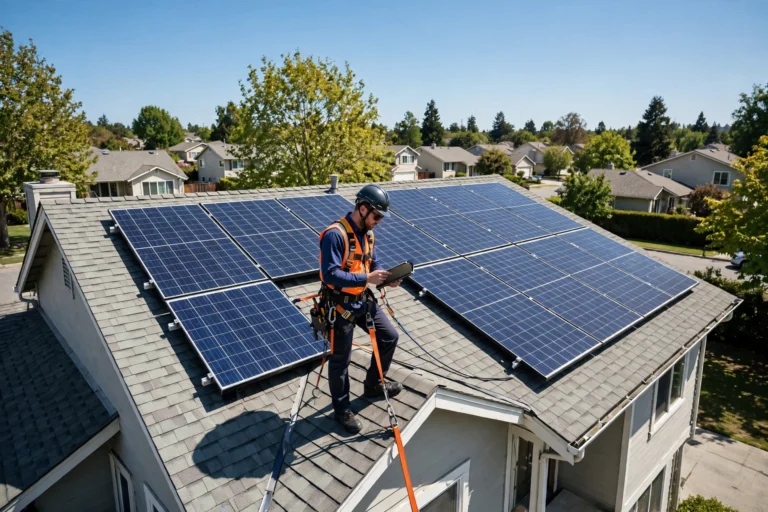
The biggest lever on residential solar panel cleaning cost is access. One-story homes with a low roof pitch and a clear ladder spot sit at the low end of the per-visit range, usually $150 to $250. Two-story homes, steep pitches, and fragile tile roofs move the job toward $350 to $500, because the crew needs more safety gear, more time, and slower footwork. Townhomes and multi-unit residential arrays often run $100 to $250, driven by panel count, roof type, pitch, and accessibility.
Condition matters too. Heavy soiling from bird droppings, caked pollen, sap, or lichen adds labor charges, and some companies add roof access surcharges of $25 to $75 or more. Drone aerial washing works from the ground, which helps on steep pitches: it often starts at a $150 minimum for up to 16 panels plus about $9 per panel. Whatever the setup, ask the solar panel cleaning service to confirm in writing what the quote covers: panel count, access method, inspection depth, and whether hard-water treatment costs extra.
Commercial solar panel cleaning cost
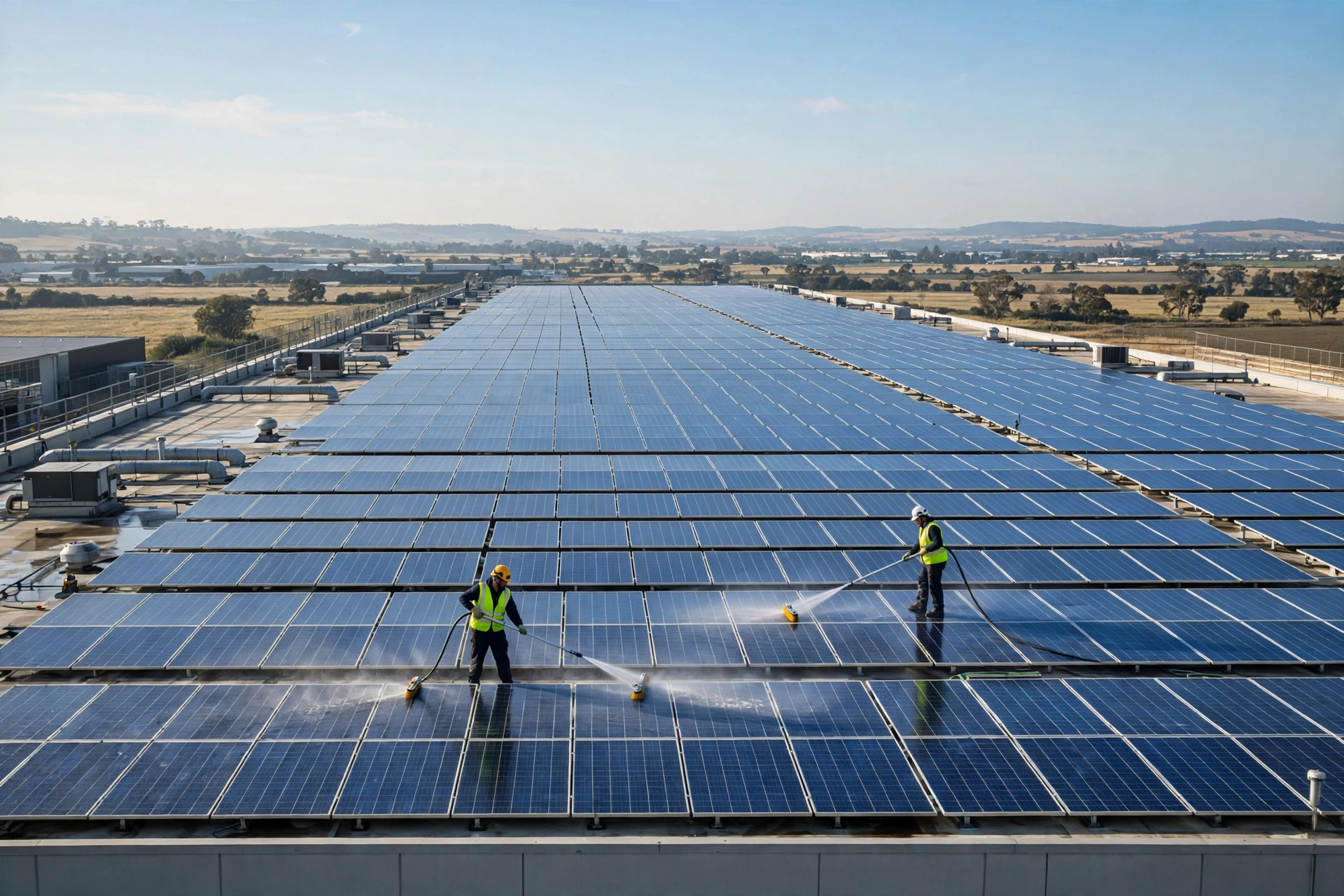
The commercial solar panel cleaning cost follows the same volume logic as residential, just at a much bigger scale. Large installations are often quoted at $0.20 to $0.35 per panel, with minimum service charges of $500 to $1,500, while standard commercial rooftop work runs $0.50 to $1.50 per panel. Other market surveys put commercial rooftop cleaning at $3 to $6 per panel, ground-mounted arrays at $2 to $5 per panel, and utility-scale projects at $1 to $3 per panel.
| Job type | Typical cost (2026) |
|---|---|
| Small to medium business, per session | $200 to $600 |
| Standard commercial rooftop, per panel | $0.50 to $1.50 |
| Large commercial install, per panel | $0.20 to $0.35 |
| Utility-scale, per panel | $1 to $3 |
| Large one-time industrial or utility clean | $1,000 to $5,000 |
A typical one-time clean of a 300-panel commercial array can run about $1,400, which shows how fast the per-panel rate drops at scale. For businesses, the commercial solar panel cleaning cost is usually rolled into annual service contracts, and those contracts typically cut the per-cleaning price by 10 to 20 percent compared with one-off visits. Some installation contracts even bundle an annual inspection plus cleaning into the original purchase, so check your paperwork before you pay for a separate visit.
Solar panel maintenance plan pricing
A maintenance plan flattens the solar panel cleaning cost across the year instead of hitting you with a surprise bill each visit. Annual plans that include cleaning plus a full inspection typically run $390 to $720 per year, while a standalone inspection alone usually costs $150 to $300. Most plan subscribers clean once or twice a year with the inspection bundled in, which is cheaper than buying the two services separately.
Over a full year, the average solar panel cleaning cost for a plan subscriber often comes out lower than two one-off visits, thanks to the 10 to 20 percent contract discount. Homeowners without a plan generally annualize between $0 and $300 per year in total maintenance, with the typical spread landing near $100 to $150 per year across the life of the system. Desert and Southwest homes on quarterly plans run above the national average, because dust buildup there never takes a season off.
How much dirt costs you
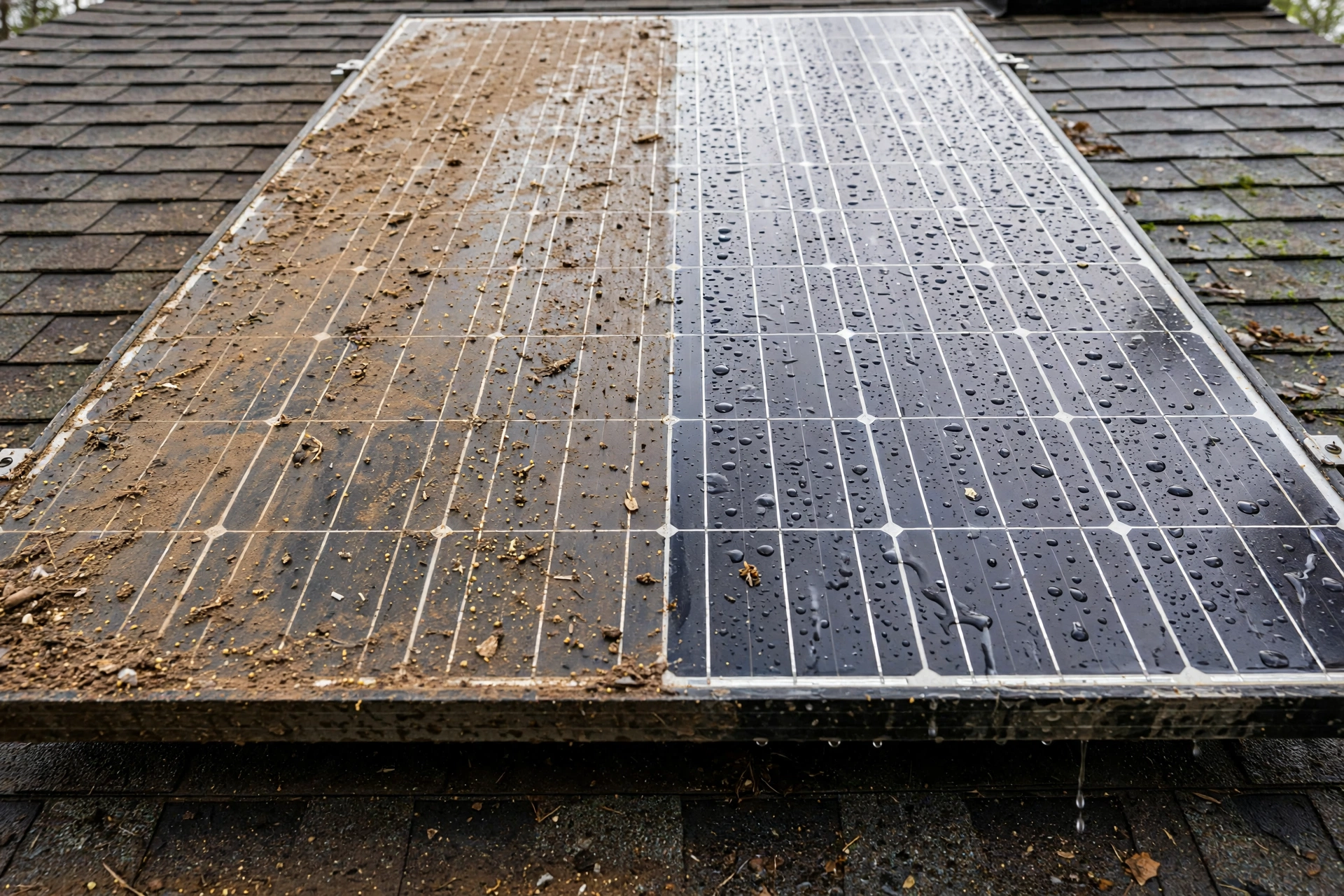
Those soiling losses are why the solar panel cleaning cost is usually dwarfed by the energy you lose by skipping cleanings. Global data puts average soiling losses at 4 to 7 percent of solar generation, but typical residential losses run 10 to 25 percent depending on location. An NREL study found pollen cutting output by up to 15 percent, with water washing restoring 5 to 11 percent. In dusty Southwest regions, neglect can cost up to 36 percent of output, and extreme cases with sap or lichen can cut efficiency by up to 50 percent. Bird droppings are sneakily expensive: each spot can cost 1 to 3 percent of power per square inch through shading, and coastal salt air can drag output down 10 to 15 percent if it is ignored.
| Climate | Recommended cleaning frequency |
|---|---|
| General and average conditions | Once per year |
| Southwest desert and high-dust or farm areas | Every 3 to 4 months |
| Coastal zones with salt air | Twice per year with mild soap |
| Urban areas with pollen and bird droppings | Once to twice per year |
| Rainy and mild climates | Every 12 to 24 months |
The standard expert recommendation is at least one professional cleaning per year, with manufacturers commonly suggesting one to two visits annually. When your inverter app shows output roughly 5 percent below comparable periods, the question shifts from how much does it cost to clean solar panels to how much lost power is costing you every month. Rain alone does not solve the problem: it rinses loose dust but leaves behind droppings, sap, pollen buildup, and mineral deposits, and NREL data confirms rain alone does not fully restore output.
What a pro solar panel cleaning service includes
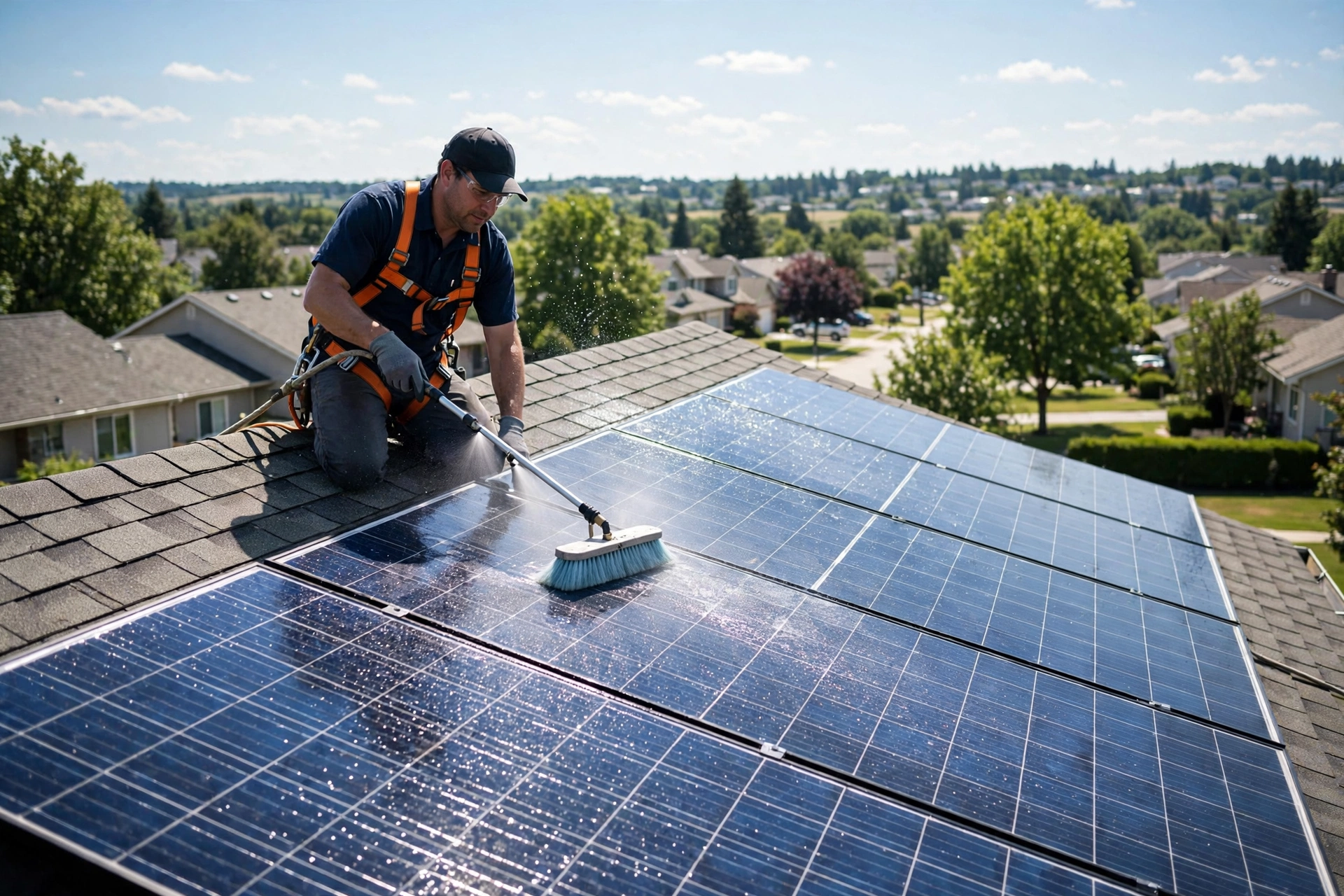
A real professional visit is more than a quick rinse. The crew washes each panel with a soft brush and purified or deionized water, finishing with a pure-water rinse that prevents calcium spotting. Deionized-water-only providers avoid chemical residues entirely, which keeps the anti-reflective coating intact and slows re-soiling.
Most reputable visits also include a visual system inspection: panel cracks and hot spots, mounting and racking condition, normal inverter operation, and visible wiring. Good contractors demonstrate the value with inverter data or before-and-after readings rather than just promising cleaner glass. Before you book, confirm exactly what is in the quote so the visit delivers the inspection you expect.
DIY vs hiring a pro
On the math alone, DIY beats the solar panel cleaning cost of a pro visit, but only if your panels are safely reachable from the ground. Water-fed pole kits sold at US retail run about $98.91 for a 26-foot kit, $159.90 for a 33-foot kit, and $199.90 for a 39-foot kit, and a simple garden hose plus a soft brush costs nearly nothing on the margin. DIY is sensible for ground-mounted arrays or panels you can reach without climbing onto the roof.
Safe DIY cleaning follows strict rules. Clean early in the morning or in the evening when the panels are cool, use clean water with a mild manufacturer-approved soap only, and stick to a soft sponge, cloth, or non-abrasive brush with a thorough rinse. Never spray cold water on hot panels in midday sun, because the thermal shock can crack the glass. And never pressure wash: most manufacturers explicitly advise against it, since high pressure can crack tempered glass, force water past frame seals into the electrical layers, strip the anti-reflective coating, and void your warranty. Never walk on the panels, and skip the abrasive sponges, metal scrapers, and harsh detergents. For rooftop, ladder, or two-story work, hire a pro and keep your feet on the ground.
Money-saving tips
- Sign an annual plan instead of booking one-off visits. Contracts usually cut the per-cleaning price by 10 to 20 percent and bundle the inspection.
- Do a safe ground-level rinse between pro visits. If your array is reachable with a hose and soft brush, a light rinse in spring stretches the time between paid cleanings.
- Watch your inverter app, not the calendar. Schedule the visit when output drops about 5 percent against comparable periods instead of cleaning on a rigid schedule.
- Get written quotes from three companies. The cheapest solar panel cleaning cost is the one you never overpay for: ask each company the same questions about panel count, access method, and inspection depth.
- Combine visits with neighbors. Some companies discount same-day cleanings on the same street, since they save a trip.
- Skip the plan if rain does the light work. In rainy, mild climates, an inspection after the wet season plus one pro visit every 12 to 24 months is often enough.
If you are still shopping for a system, our guide to solar panel installation costs breaks down what a new array runs before cleaning ever enters the picture. Homeowners pairing panels with batteries should also see our breakdown of solar battery storage costs to budget the full system, since a well-maintained array charges the battery faster and pays the cleaning cost back through higher stored energy.
FAQs
How much does it cost to clean solar panels?
Most homeowners pay $150 to $500 per professional visit, or $5 to $20 per panel. The average solar panel cleaning cost for a typical 18 to 25 panel single-story home lands near $200 to $350, while steep or tile roofs and 30-plus-panel systems run toward $350 to $500.
How often should solar panels be cleaned?
Once or twice a year is the standard recommendation, and manufacturers commonly suggest one to two visits annually. Homes in dusty desert regions need cleaning every 3 to 4 months, coastal homes twice a year to fight salt, and rainy mild climates can often go 12 to 24 months between pro visits.
Can I clean solar panels myself?
Yes, for ground-mounted or ground-reachable panels, using a garden hose, a soft brush, and mild manufacturer-approved soap during the cool morning or evening hours. Doing it yourself avoids the solar panel cleaning cost of a visit entirely, but hire a pro for rooftop, ladder, or two-story work, and never use a pressure washer.
Will rain clean my solar panels?
Rain removes loose dust but not bird droppings, sap, pollen buildup, or mineral deposits. NREL data shows rain alone does not fully restore output, so panels in pollen-heavy or coastal areas still need a proper wash.
Does cleaning void the solar panel warranty?
No, not when you use manufacturer-approved methods such as pure water and a soft brush. Pressure washers, abrasive pads, metal scrapers, and harsh chemicals can damage the glass or its coating and void the warranty, so always check your manufacturer\u2019s cleaning instructions first.
How much efficiency do dirty solar panels lose?
Typical residential losses run 10 to 25 percent depending on location, while global data puts average soiling losses at 4 to 7 percent. Dusty regions can see 30 percent or more, and extreme cases with heavy sap or lichen buildup can cut output by up to 50 percent. That lost output is the hidden side of the solar panel cleaning cost equation.