Garbage Disposal Installation Cost 2026
Garbage disposal installation costs $150 to $950 in 2026, with most homeowners spending around $550 for a professional replacement. A simple swap of an existing unit is the cheap end of the job; a kitchen that has never had a disposal lands at the expensive end because of the electrical work involved. Figures below reflect 2026 national contractor pricing; your local quote may vary, so get 3 local quotes from licensed plumbers before committing.
Of all the small appliances in a kitchen, the garbage disposal gets the least respect until it dies. Then, suddenly, the sink is clogged, the kitchen smells like last Tuesday, and you realize how much of your daily cleanup depends on that humming little can under the sink. A disposal swap is one of the quickest professional jobs in plumbing, but the price swings widely depending on one question: is there already a disposal down there, or is the electrician coming too?
How much does garbage disposal installation cost in 2026?
The total spread for a professionally installed disposal is $150 to $950, and the national average sits around $550. Most of the quotes real homeowners get fall between $400 and $550 for a straightforward replacement with existing plumbing and electrical connections. A comprehensive service estimate from industry data puts the national average between $493 and $578 per unit installed.
| Job type | Typical cost (2026) |
|---|---|
| Same-model swap, labor only | $120 to $200 |
| Simple replacement swap (unit + labor) | $200 to $350 |
| Standard replacement (new unit, existing connections) | $200 to $650 |
| Replacement with corroded plumbing | $250 to $400 |
| Typical homeowner project | $400 to $550 |
| First-time install (no existing disposal) | $750 to $1,400+ |
| National average | ~$550 |
See the pattern? Everything under $650 assumes the sink already has the plumbing and the outlet. The moment new electrical work enters the picture, you are in a different price tier. Keep that in mind when you see a rock-bottom quote online; it almost always assumes a simple swap.
Disposal prices by horsepower: which one do you need?
The disposal itself is the part you choose. Prices vary by horsepower, brand tier, and noise insulation. The unit price before labor runs from about $50 for a basic 1/3 HP model to $420 or more for a premium 1 HP machine.
| Horsepower | Unit price (2026) | Best for |
|---|---|---|
| 1/3 HP (basic) | $50 to $140 | Light use, apartments, rentals; shortest lifespan |
| 1/2 HP (standard) | $99 to $180 | Most households; handles everyday scraps fine |
| 3/4 HP (mid-range) | $125 to $200 | The sweet spot; quieter, tougher, worth the upgrade |
| 1 HP (premium) | $200 to $420+ | Heavy cooks, large families, serious food prep |
Multiple pros call the 3/4 HP unit the sweet spot for most homes. A 1/2 HP disposal handles everyday scraps for the average household, but the step up to 3/4 HP buys noticeably quieter grinding, better stainless components, and a longer life. The 1 HP tier is for people who cook a lot or have a big household; it is overkill for a light-use kitchen.
Brand matters too. Waste King is the value leader, with stainless internals and long warranties at budget prices. InSinkErator’s Badger line is the classic builder-grade choice with a short 2-year warranty, while its Evolution line costs more but grinds quieter and carries 8 to 9 year warranties. Moen sits in a strong value position in the mid tier, with stainless components, an included power cord, and 5 to 10 year warranties.
A few upgrades move the unit price up: batch-feed models add $50 to $150 over continuous feed, insulation adds $100 to $200, ultra-quiet tiers add $200 to $400, multi-stage grinding adds $50 to $300, and septic-rated units add $50 to $90. Unless noise really matters in an open kitchen, skip the ultra-premium tier; the money rarely comes back to you in performance.
Labor: what the pro charges and why
For a like-for-like swap, a pro is usually in and out in 45 minutes to 1.5 hours. Standard jobs run 1 to 3 hours including mounting, plumbing alignment, and leak checks. Flat-rate labor for a swap lands between $120 and $200 in most markets, while licensed plumbers quote $250 to $450 flat in higher-cost metro areas. Big-box installation services, like the ones from Home Depot, charge $159 to $189 in flat labor with the unit sold separately, which is a useful baseline when comparing quotes.
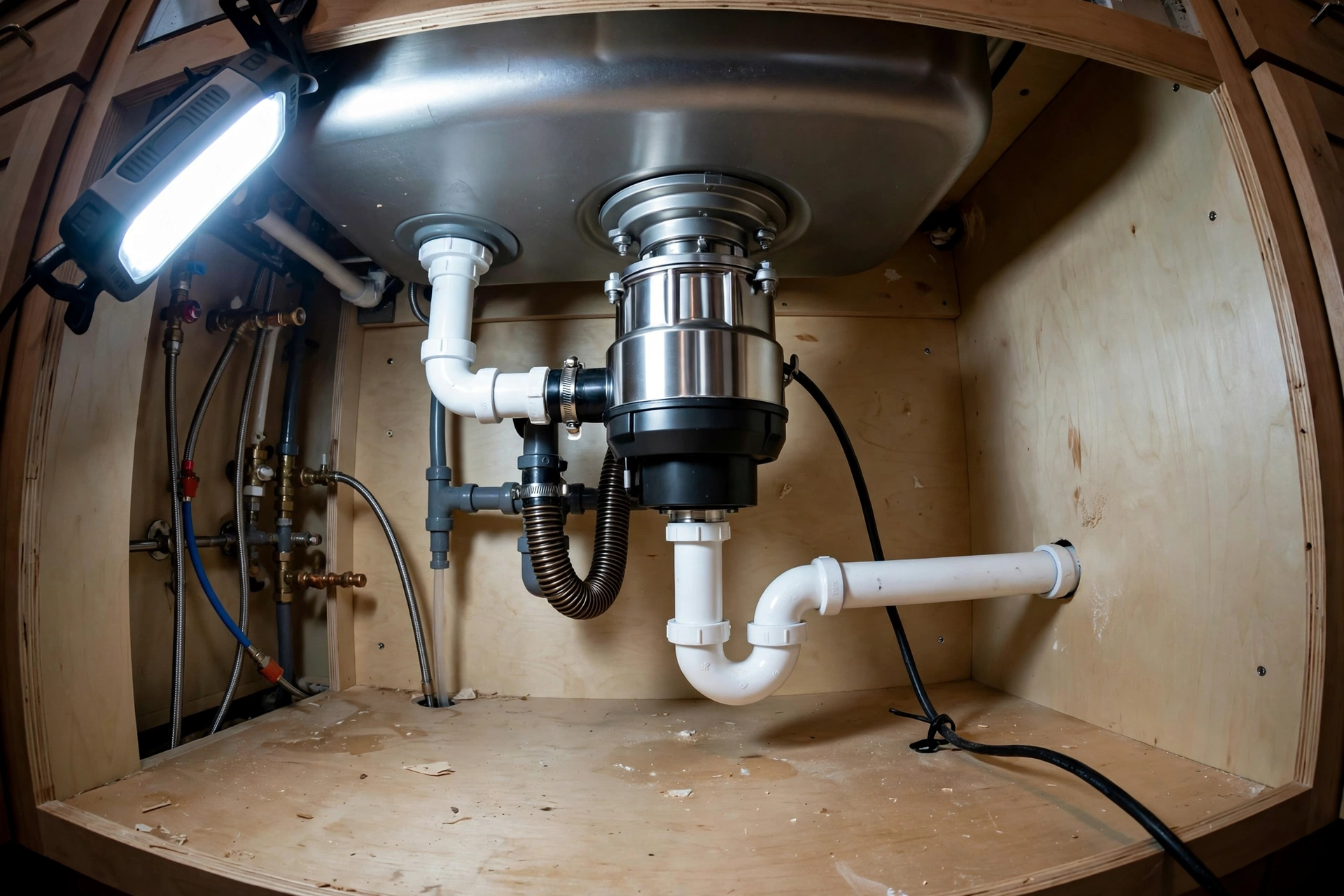
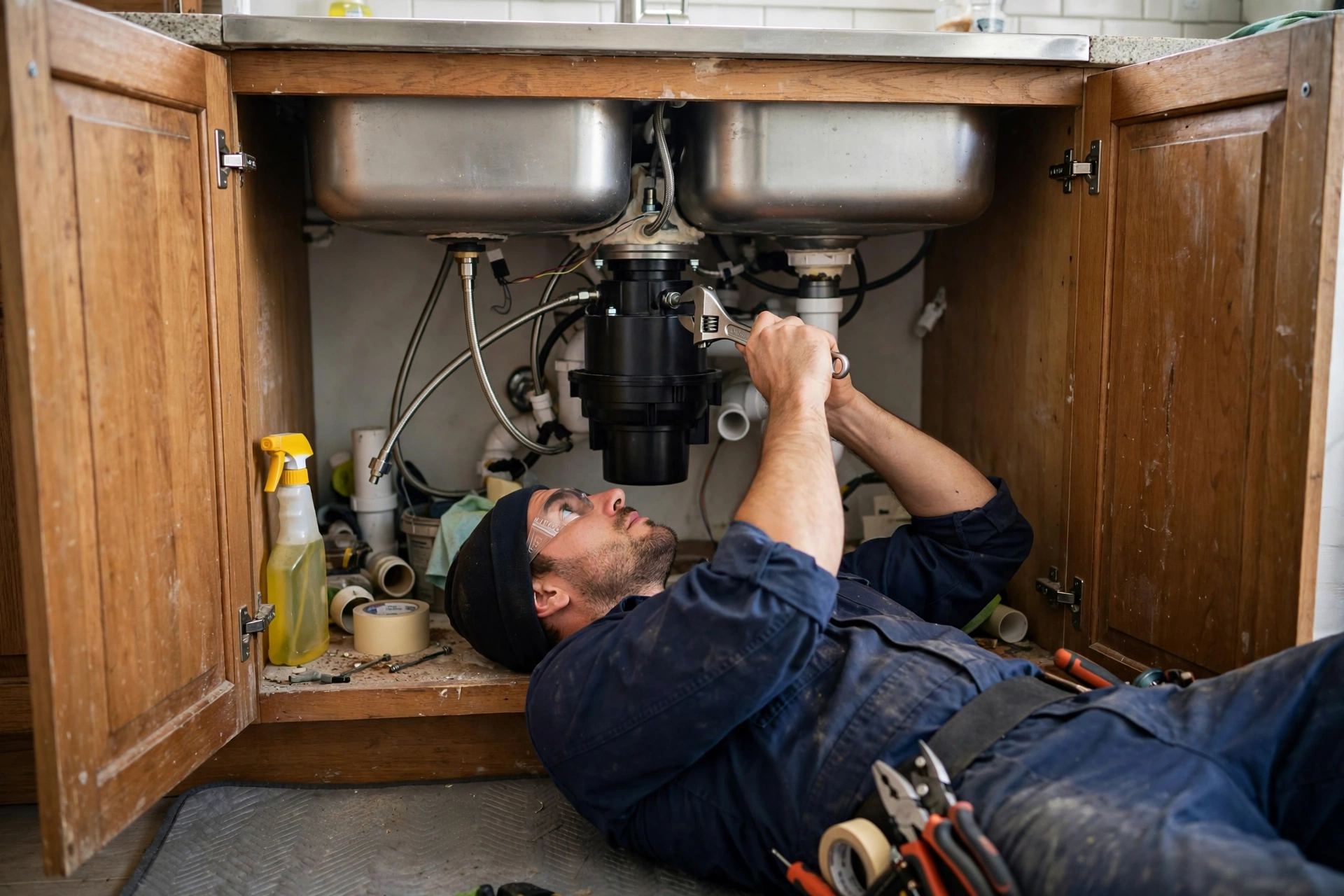
That labor covers more than it looks like. The old unit comes out (which can be a fight if the plumbing is corroded), the new flange gets sealed with plumber’s putty, the mounting ring goes on straight, the dishwasher connection gets hooked up, and everything gets run and checked for leaks under pressure. Corroded or seized old units push replacement labor toward $250 to $400 because nothing about that job is quick.
The hidden cost of a first-time install
Here is where the budget gets real. If your kitchen has never had a disposal, the unit is the cheap part. The expensive part is the electrician. A first-time install runs $750 to $1,400 or more, and nearly all of that premium is electrical work: a new dedicated circuit run from the panel costs $400 to $700, a GFCI outlet under the sink adds $100 to $300, and the electrician’s add-on visit runs $150 to $300.
This is why so many “cheap disposal install” stories are actually swap stories. If you are adding a disposal where none existed, budget for both trades: the plumber for the plumbing and mounting, the electrician for the circuit and outlet. Some pros handle both if they are licensed for it, which can save you a second service call fee.
Extra costs that show up on the quote
Beyond the unit and basic labor, a few common add-ons appear on real quotes. Knowing them in advance keeps the invoice from surprising you.
| Extra | Typical cost (2026) |
|---|---|
| Dishwasher hookup connection | $75 to $150 |
| Air switch (sink-top alternative to wall switch) | $75 to $150 |
| Plumbing modifications (P-trap, drain rework) | $100 to $300 |
| Pipe replacement or reconfiguration | $350 to $600 |
| New dedicated circuit from panel | $400 to $700 |
| GFCI outlet under the sink | $100 to $300 |
The air switch is a nice touch for many kitchens. Instead of a wall switch, you get a small button mounted on the sink deck that turns the disposal on with a puff of air. It costs $75 to $150 installed and avoids putting an electrical switch where wet hands reach. The dishwasher hookup matters if your dishwasher drains through the disposal; that connection is standard work but it is billed when it needs a knockout and fitting.
If your kitchen is mid-remodel, this is the cheapest time to add a disposal. The walls are open, the electrician is already there, and the plumber is already under the sink. Related reads: dishwasher installation costs, kitchen countertop costs, and water heater installation costs.
What affects the total price?
- Existing connections. The single biggest factor. Swap with existing plumbing and electrical: cheap. First-time install needing a new circuit: expensive.
- Unit choice. A $100 basic unit and a $400 premium unit change the total by $300 for the same labor.
- Plumbing condition. Corroded traps, seized mounting rings, and misaligned drains add labor and parts.
- Sink material. Some sink materials need more care during flange installation, adding time.
- Local labor rates. Plumber rates vary widely by metro; high-cost markets run $250 to $450 flat for the same swap a small market does for $120 to $200.
- Permit requirements. Some jurisdictions require permits for new electrical circuits, adding a small fee.
How long does a garbage disposal last?
Expect 8 to 12 years from a typical disposal. Budget 1/3 HP units often fail at 6 to 8 years; premium 3/4 and 1 HP units with stainless internals reach 13 to 15 years. That lifespan math is part of the unit decision: a $150 mid-range unit that lasts 12 years costs less per year than a $90 budget unit you replace twice.
Know the signs that replacement beats repair: a leak from the bottom housing (failed internal seals, not fixable), a motor that hums but does not spin (jam first, then burnout), frequent trips of the reset button, persistent odors that cleaning does not fix, or any unit past 8 years with problems. The general rule from the trade: repair a jammed, under-warranty, or newer high-end unit; replace if the repair quote is 50 percent or more of a new install.
DIY vs hiring a pro
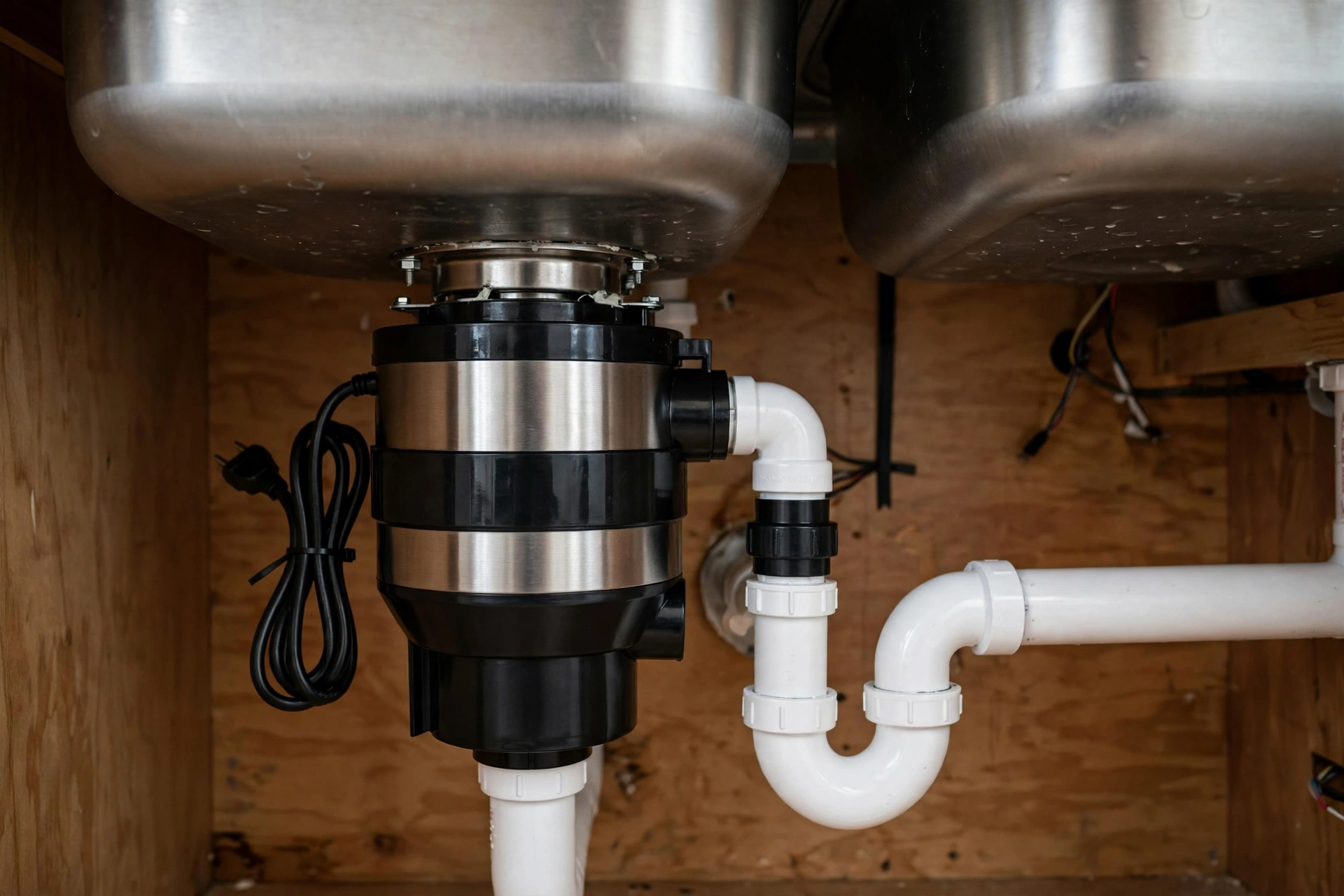
A like-for-like swap is rated moderate difficulty, and it is a realistic DIY job if the unit is corded and plugs into an existing outlet. The steps are straightforward: turn off the breaker (not just the switch), disconnect the old unit, seal the new flange with plumber’s putty, mount the new unit, connect the plumbing, and run it while checking every joint for leaks. A DIY swap costs $75 to $250 for the unit alone.
Hire a pro for a first-time install, any wiring work, corroded plumbing, or if the old unit will not budge. And memorize the classic DIY mistake: forgetting to knock out the dishwasher drain plug inside the disposal’s dishwasher inlet neck. If your dishwasher drains through the disposal, that little plastic plug must come out before you connect the hose, or the dishwasher will not drain. Other common errors: skipping the GFCI-protected circuit, cross-threading the mounting ring, failing to reseal the flange putty, and never checking the reset button after a jam.
Money-saving tips
- Keep the same mounting system. Sticking with the same brand family often lets you reuse the existing sink flange and mounting ring, which makes the swap faster and cheaper.
- Buy the unit yourself. Plumber markup on the unit is real. Bring your own box and pay for labor only, but confirm the pro is fine with customer-supplied units first.
- Skip the ultra-premium tier. Unless your kitchen is open to the living room and noise truly bothers you, the mid-range unit gives the best value per year of life.
- Check big-box install pricing. Home Depot and Lowe’s charge $159 to $189 in flat labor, which gives you a solid baseline to compare independent plumber quotes against.
- Get flat-rate quotes. Ask three local plumbers for flat-rate pricing on the same job (same unit, same scope). Flat quotes are easier to compare than hourly ones.
- Bundle with other work. If the plumber is already under your sink for the dishwasher or faucet, adding the disposal swap to the same visit saves a service call fee.
FAQs
How much does it cost to install a garbage disposal?
Professional installation costs $150 to $950 in 2026, averaging around $550. A simple replacement swap with existing connections runs $200 to $350; a first-time install needing new electrical work runs $750 to $1,400 or more.
How long does it take to install a garbage disposal?
A like-for-like swap takes 45 minutes to 1.5 hours for a pro. Standard replacements run 1 to 3 hours. First-time installs take longer because of the new circuit and outlet.
Can I install a garbage disposal myself?
Yes, if it is a corded replacement swap into an existing outlet. Turn off the breaker first, seal the new flange with plumber’s putty, and check every joint for leaks. Hire a pro for first-time installs, wiring work, or corroded plumbing.
Do I need an electrician to install a garbage disposal?
Not for a swap that plugs into an existing outlet. You do need one for a first-time install that requires a new dedicated circuit and GFCI outlet under the sink, which is where most of the $750 to $1,400 first-time cost comes from.
What size garbage disposal do I need?
1/2 HP suits most households. 3/4 HP is the sweet spot for most buyers: quieter, more durable, and worth the small price step up. Choose 1 HP for heavy cooking or large families. Skip 1/3 HP unless it is a light-use apartment or rental.
Can I use a garbage disposal with a septic system?
Usually yes, but with caveats. Use a septic-rated unit with a finer grind, which adds $50 to $90, and consider having the tank pumped more often since the disposal adds solids to the system. Standard models are legal on septic in most jurisdictions, but the septic-rated grind is easier on the tank.