Septic System Installation Cost 2026
If your home is not connected to a city sewer, a septic system is not an optional extra. It is the system that makes the house livable, and on a rural parcel a permitted system is usually a condition of the building permit itself. The first question most buyers and homeowners ask is a practical one: what is the septic system installation cost in 2026?
The short answer is that the average septic system installation cost runs about $8,016, with a typical range of $3,590 to $12,463, based on 1,277 verified projects tracked by Angi and updated in October 2026. That range is wide because a septic system is not one product. A simple gravity system in good soil costs a fraction of an engineered mound or aerobic system on a difficult lot, and the test that decides which one you need comes before any digging starts.
This guide breaks down the septic system installation cost by system type, by tank size, and by the pre install steps that decide the budget. It also covers drain field costs, permits, ongoing upkeep, and how septic compares with city sewer. Every price here is a 2026 US contractor market estimate, not a fixed quote. Get 3 local quotes before you commit, and make sure each one prices the same system type, the same tank size, and the same drain field.
Perc Test First: The Result That Decides the Budget
Before you compare a single septic system installation cost figure, understand the perc test. A perc test measures how fast water drains through the soil on your lot. That result, together with the water table depth, bedrock depth, and lot size, decides which system your health department will approve. A passing perc test keeps a conventional gravity system on the table. A slow perc test, a high water table, shallow bedrock, or a small lot forces an engineered alternative and can roughly double the budget. A failed perc test across the whole parcel can mean the lot cannot support any approved system at all.
That is why the septic system installation cost conversation should start with soil, not with a tank catalog. The order of work is perc and soil evaluation first, then system design, then permit, then install. If you are buying land, put a perc contingency in the purchase contract so you are not committed to a lot that cannot support a system. Size the system for planned bedrooms too, since the health department sizes by bedroom count.
A perc and soil evaluation typically costs $700 to $2,000. That budget figure is a small share of the total septic system installation cost, but it decides the system that follows. A basic perc only test can be cheaper in some guides, at $250 to $1,000, but do not confuse that narrow test price with the full evaluation budget. The full evaluation is what the designer and the health department actually work from, and it is the number to carry into your septic system installation cost planning.
How Much Does a Septic System Cost?
So, how much does a septic system cost in 2026? For most homes the answer sits inside the Angi band above, but the system type moves the septic system installation cost more than any other factor. The table below shows the septic system installation cost by system type, with the headline band for each.
| System type | Typical installed cost | Best for |
|---|---|---|
| Conventional gravity | $3,500 to $8,000 | Good soil, adequate space, gravity fall from house to field |
| Chamber (pressurised) | $5,000 to $12,000 | Marginal soil or an uneven lot |
| Mound | $10,000 to $25,000 | High water table, slow perc, or shallow bedrock |
| Aerobic treatment unit (ATU) | $10,000 to $20,000 | Tight lots, poor soil, or strict rules near water |
| Drip irrigation | $8,000 to $18,000 | Small lots needing shallow dispersal |
| Sand filter | $7,000 to $14,000 | Poor soil and high water table |
| Low pressure pipe (LPP) | $5,000 to $15,000 | Marginal soil |
Engineered systems can run to $25,000, and difficult lots to $30,000 or more, so a quote above the typical band is not automatically bad. It may simply reflect a mound or aerobic system that your soil requires.
Septic Tank Installation Cost: Tank Only vs Full System
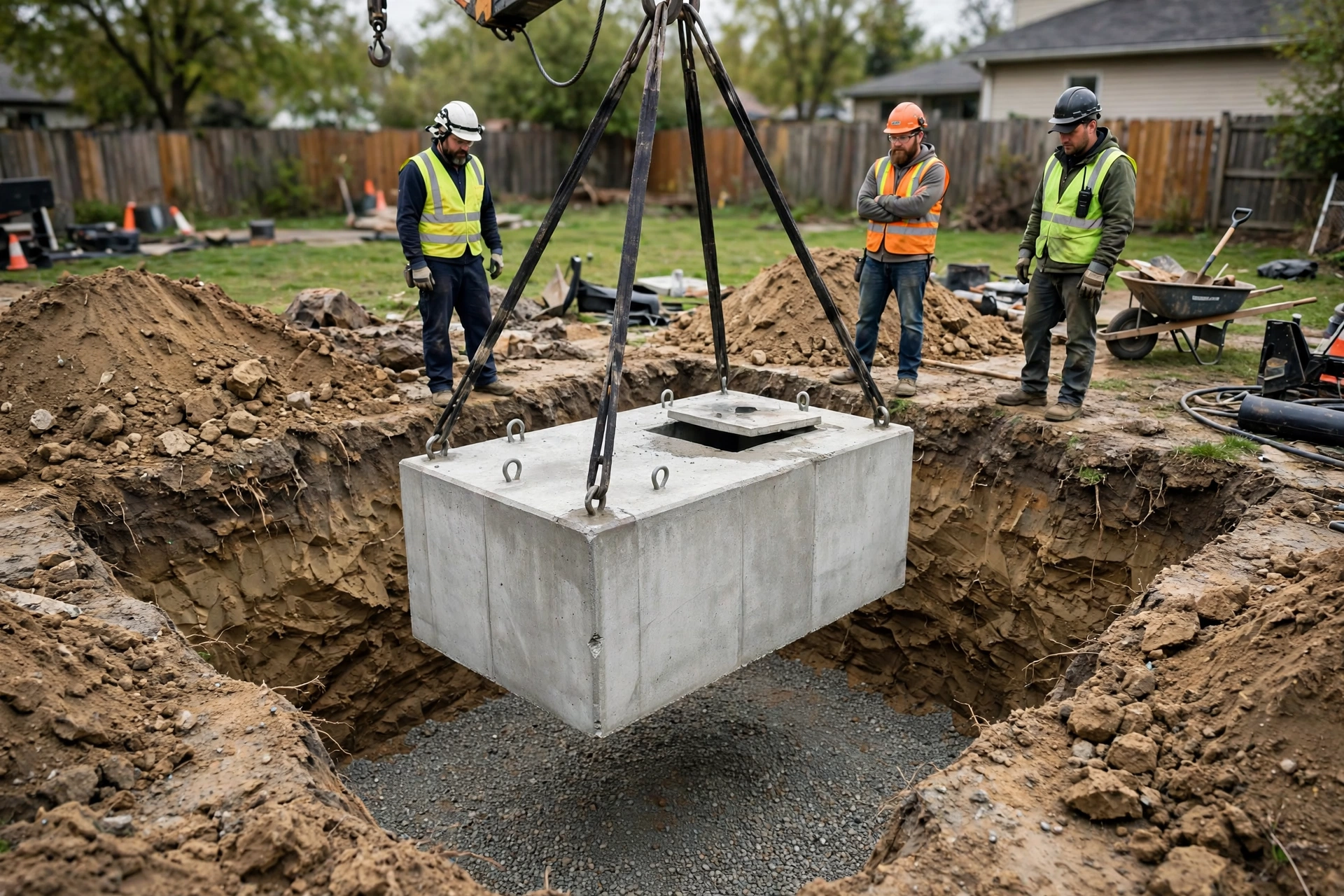
One of the easiest mistakes in septic pricing is confusing septic tank installation cost with the full septic system installation cost. The tank is only one part of the job. The drain field, the piping, the excavation, and the permits make up the rest, and the field alone is often the largest single line item.
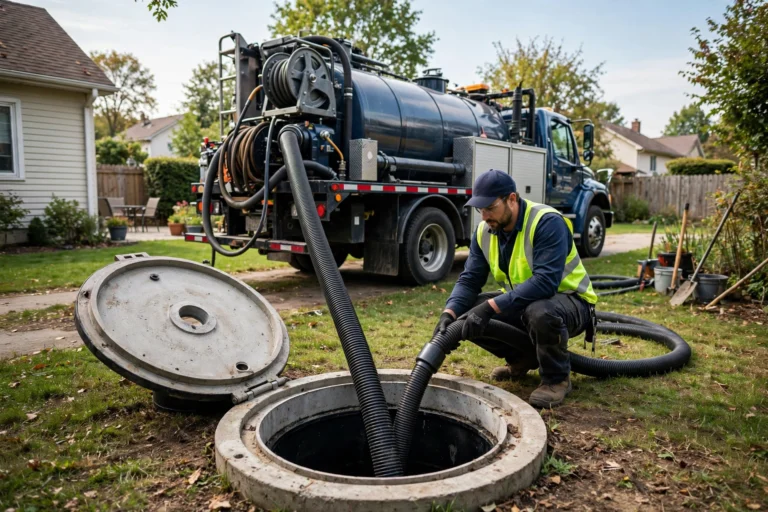
A 1,000 gallon tank alone costs about $900 to $1,500 for the tank itself, for a typical 3 bedroom home. A tank only replacement that reuses an existing drain field runs $3,000 to $10,000 installed. Those figures are useful when an old tank has failed but the field is still sound. They are not the septic system installation cost of a new system on a new lot, and any comparison should keep the two jobs separate.
Tank sizing, a key input to the septic system installation cost, follows a simple rule of thumb. A 750 gallon tank suits 1 to 2 bedrooms, a 1,000 gallon tank suits 3 bedrooms, a 1,250 gallon tank suits 4 bedrooms, and a 1,500 gallon tank suits 5 or more bedrooms. Some states require larger tanks, so the health department figure governs, not the rule of thumb. Concrete is the most common tank material, plastic is lighter and cheaper but less durable, and fiberglass is a premium option. Tanks typically last 30 to 50 years when pumped on schedule.
Septic Drain Field Installation Cost
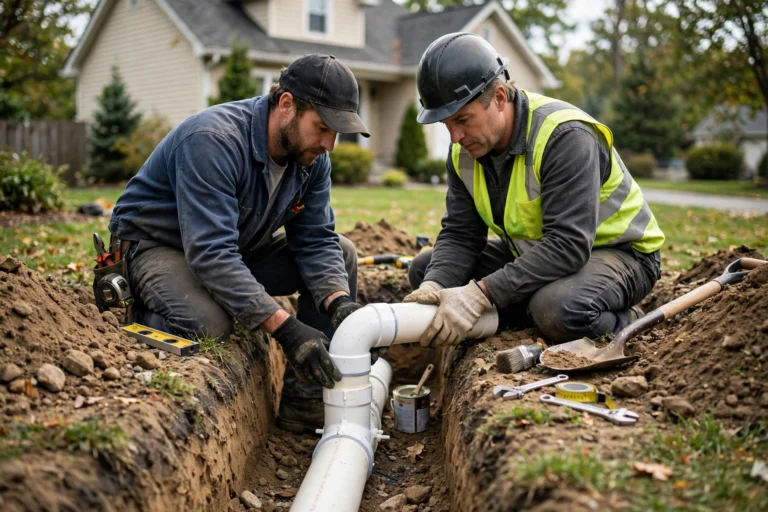
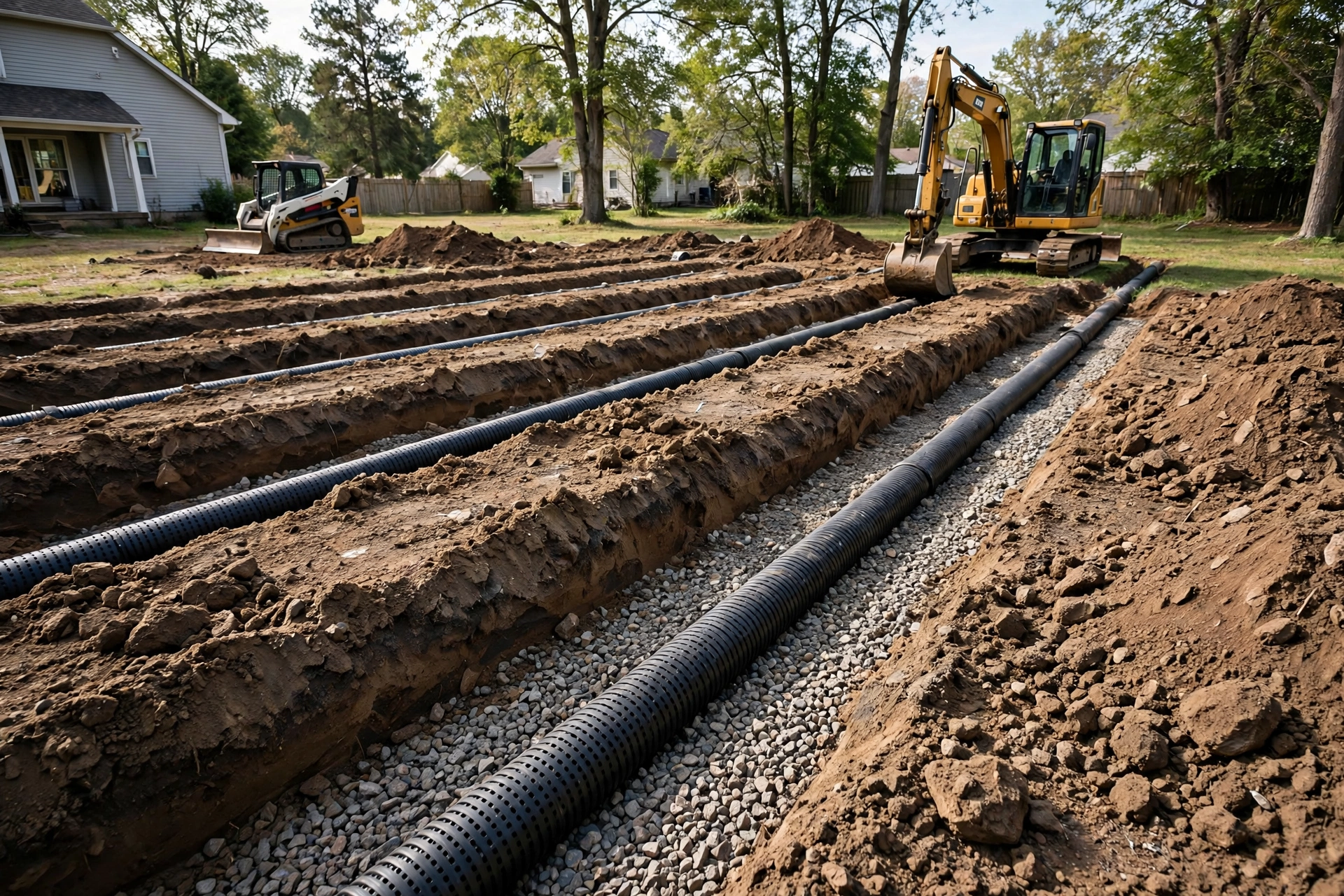
Septic drain field installation cost deserves its own section, because the field is where most of the money and most of the risk sit. A new drain field installation alone runs $5,000 to $12,000. A drain field replacement alone runs wider, at $3,000 to $15,000 in one guide table and $5,000 to $20,000 or more in others, because replacement means removing the old field and laying out a new one, often in a reserve area.
The drain field is 40 to 60 percent of the bill in the usual framing of septic system installation cost, and one fresh guide puts the combined tank and leach field at 50 to 60 percent of the total budget. The field size follows directly from the perc result and the bedroom count, which is why a bad perc result moves the whole budget. More bedrooms mean more wastewater, and slower soil means more field area to absorb it.
Protect the field after install. Do not drive or pave over it, and keep the reserve area clear for a future field if the health department required one.
Pre Install Costs: Permits, Design, and Excavation
Several costs land before the tank ever arrives on site, and they belong in any honest septic system installation cost total. Permits run $450 to $2,300 in the Angi band, and the fee depends on the county. Some guides quote the permit fee alone at $200 to $1,000, and permits plus design and engineering at $500 to $2,500 where a licensed designer is required. Ask your installer which bucket your quote uses, so a low permit line is not hiding a separate design fee.
Excavation is another line to check. Where excavation is not included in the base price, add $1,500 to $6,300. A pump chamber where the site needs one adds $1,500 to $3,000. For a pump up system, budget a pump at $400 to $900, a pump tank at $1,200 to $2,500, and an electrical run at $500 to $2,000 depending on distance and trenching. None of these are extras invented to pad a quote. They are real site conditions, and a good quote lists them separately rather than burying them in a single lump sum.
Regional labor also moves the septic system installation cost, with a 20 to 40 percent spread between low cost rural areas and high cost suburban areas.
Aerobic vs Conventional Septic System Cost
The aerobic vs conventional septic system cost comparison is the decision most buyers on marginal lots actually face. A conventional gravity system costs $3,500 to $8,000 for a standard 3 bedroom home, and up to about $12,000 for larger homes and longer fields. It needs soil that passes perc, adequate space, and gravity fall from the house to the field. It has no pump and no electricity, and its upkeep is the lowest of any system, at $75 to $150 per year.
An aerobic treatment unit, the expensive end of septic system installation cost, costs $10,000 to $20,000 as the headline band, and up to $25,000 where the lot or the rules demand more treatment. It mechanically treats effluent with oxygen before dispersal, which is why it can work on tight lots, poor soil, or near water where a conventional system cannot. The tradeoff is ongoing: it needs electricity, a pump or blower, and a mandatory service contract in most states, with annual upkeep of $300 to $500. Mechanical parts typically last 5 to 10 years, so budget for service and eventual part replacement, not just the install price.
The EPA guide to septic system types explains how each system treats and disperses wastewater, and it is worth reading before you choose. The right choice is usually the simplest system your soil and health department will approve.
Septic vs City Sewer: A Fair Comparison
For septic system installation cost purposes, septic is the only option where no sewer line reaches the lot. A city sewer connection on private property averages about $3,464, with a typical range of $1,422 to $5,757 and extremes to $10,000, plus municipality tap and connection fees as a separate bucket. That comparison is useful only where a sewer line actually exists and a connection is possible. Where no line exists, sewer connection is not a like for like alternative, and the septic price is the price of having a working home at all.
If you are weighing a sewer connection against keeping a septic system, our guide to sewer line replacement cost covers the trenchless versus traditional methods and prices for work on an existing line. For an existing system, compare pumping and upkeep against a monthly sewer bill.
Ongoing Costs, Lifespan, and What Ruins a System
A septic system installation cost quote is only the first cost. Pumping, the main recurring cost after the septic system installation cost, runs every 3 to 5 years at $300 to $600, and skipping pumping is the leading cause of drain field failure. A failed field repair runs $5,000 to $15,000 or more, which dwarfs the cost of regular pumping. Annual upkeep by system type runs $75 to $150 for conventional, $100 to $200 for chamber, $100 to $300 for mound, $300 to $500 for aerobic, and $150 to $350 for drip systems.
Lifespans help put those costs in context. Tanks last 30 to 50 years, drain fields last 20 to 30 years, and aerobic mechanical parts last 5 to 10 years. What ruins a system is mostly avoidable: harsh chemicals, paint thinners, pesticides, and anything other than waste and toilet paper flushed down the toilet, because they kill the bacteria the tank needs to break waste down. The EPA septic systems overview covers maintenance basics that every owner should know, and it is a good check against any installer advice that sounds too casual about upkeep.
Septic work is licensed designer and installer work in most states. Never let an unlicensed installer skip the health department permit, which protects you at resale.
How to Compare Quotes
Compare septic system installation cost quotes line by line, not by the headline total alone, because the septic system installation cost total hides as much as it reveals. Each septic system installation cost quote should name the system type, tank size and material, drain field size and type, perc result, permit and design fees, excavation scope, pump or electrical work, and lawn or driveway restoration. A quote that omits the field size or the permit fee is not comparable to one that includes them.
Ask how the installer handles a failed inspection, a rock ledge found during digging, or a water table higher than expected. Get 3 local quotes, and favor the clearest scope over the cheapest headline.
For the ongoing side of ownership, our guide to septic tank pumping cost breaks down pumping prices by tank size and frequency, and our guide to septic inspection cost covers what an inspection checks before a home sale. Read both before you sign, so the install quote and the lifetime costs are judged together.
Frequently Asked Questions
How much does a septic system cost?
The average septic system installation cost is about $8,016, with a typical range of $3,590 to $12,463. Engineered systems on difficult lots can run to $25,000 or more.
How much does a septic tank installation cost on its own?
A 1,000 gallon tank alone costs about $900 to $1,500. A tank only replacement that reuses an existing drain field runs $3,000 to $10,000 installed.
How much does a septic drain field installation cost?
A new drain field installation alone runs $5,000 to $12,000. Replacement of a failed field runs wider, because it means removing the old field and laying out a new one.
How much does a perc test cost?
A perc and soil evaluation typically costs $700 to $2,000. A basic perc only test can be $250 to $1,000 in some guides, but the full evaluation is the budget figure to plan from.
Is aerobic or conventional cheaper?
Conventional is cheaper, at $3,500 to $8,000 for a standard home, against $10,000 to $20,000 for aerobic. Aerobic is the right choice only where soil, lot size, or rules rule out a conventional system.
How long does a septic system last?
Tanks last 30 to 50 years, drain fields last 20 to 30 years, and aerobic mechanical parts last 5 to 10 years, provided the system is pumped every 3 to 5 years and not abused.
Can a lot fail a perc test?
Yes. If the whole parcel fails perc, it may not support any approved system. That is why a perc contingency in a land purchase contract matters so much.