
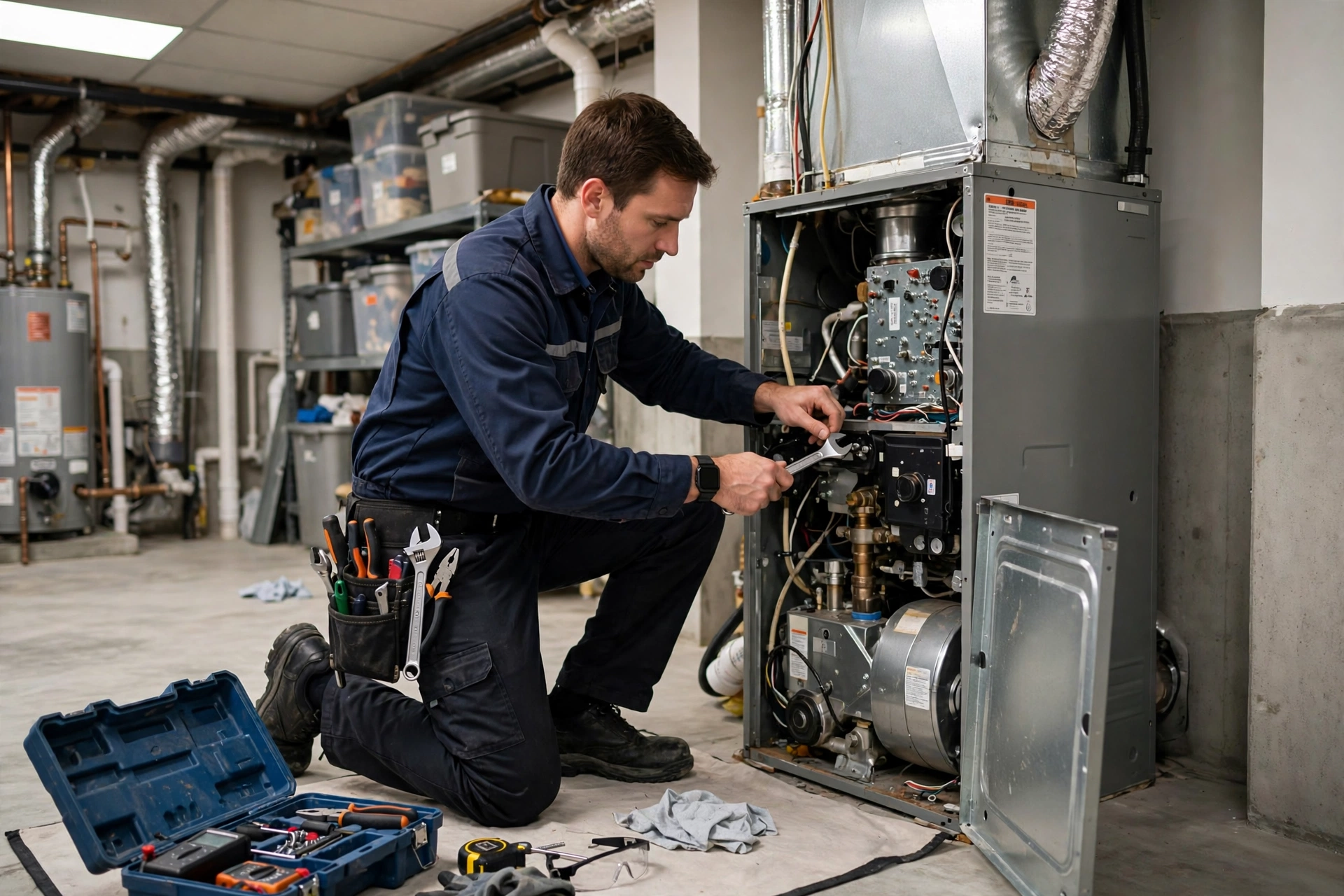
Furnace Repair vs Replace: Cost Comparison 2026
Quick answer: In 2026, repair your furnace if it is under 10 years old and the repair quote is less than half the cost of a new furnace. Replace it if it is 15 years or older, or the repair costs more than half a replacement. Between 10 and 15 years, it depends on the quote, the repair history, and the condition. Use the free calculator below to run your own numbers.
If you spend five minutes in r/HVAC, you will see this question asked over and over, usually by someone standing in a cold house at 10 pm with a dead furnace and a $1,800 quote in hand. It is one of the hardest calls a homeowner makes, because both answers feel risky. Repair it and you might be throwing money at a dying system. Replace it and you might be spending $5,000 when a $300 part would have done the job.
HVAC techs have a shortcut for this, and it is the same one you will see quoted on nearly every honest contractor blog: the 50%-rule, combined with the age of your furnace. This guide explains how it works, what repairs actually cost in 2026, and the one safety exception that overrides every rule.
The 50%-Rule, Explained
The rule is simple. Divide your repair quote by the cost of a full furnace replacement. If the repair costs more than 50% of a new furnace, replacement usually wins. If it is well under half, repair usually wins.
Here is how the math looks on a typical $4,500 furnace replacement:
- $800 repair (about 18% of replacement): Repair it. This is a no-brainer on almost any furnace.
- $1,600 repair (about 36% of replacement): Probably repair, unless the furnace is old and breaking down often.
- $2,600 repair (about 58% of replacement): Replace it. You are putting more than half a new furnace into the old one.
But the 50%-rule alone is not enough, and this is the part homeowners get wrong. A $400 repair on a 20-year-old furnace that broke twice last winter is still money down the drain. That is why the pros pair the rule with age:
- Under 10 years old: Repair, in most cases. The system has plenty of life left, and many parts may still be under manufacturer warranty.
- 15 years or older: Replace, in most cases. Efficiency has dropped, breakdowns get more frequent, and replacement parts can be hard to find.
- 10 to 15 years: The gray zone. This is where the quote, the repair history, and your energy bills decide.
One more rule you will see online is the $5,000 rule: multiply the furnace age by the repair cost, and replace if the result tops $5,000. It is a rougher shortcut. The 50%-rule plus age is the version most working techs actually use, so that is what we built the calculator around.
Try the Free Repair vs Replace Calculator
Plug in your furnace age and the two quotes. The calculator applies the 50%-rule and the age factor, then gives you a clear recommendation with the reasoning.
Furnace Repair vs Replace Calculator
Answer three questions and get an instant recommendation based on the 50% rule and your furnace’s age.
Planning estimate only, not a substitute for a professional diagnosis. Prices vary by market, brand, and parts availability. Always get 3 local quotes before deciding.
What Furnace Repairs Cost in 2026
The decision starts with knowing what a fair repair costs. These are 2026 national estimate ranges for the most common gas furnace repairs, parts and labor included:
| Repair | Typical cost (2026 estimate) | Notes |
|---|---|---|
| Service call / diagnostic visit | $75 – $200 | Often credited toward the repair if you hire them |
| Ignitor replacement | $150 – $300 | Most common repair; OEM parts cost more than universal |
| Flame sensor or thermocouple | $75 – $250 | Often cleaned first, replaced only if cleaning fails |
| Thermostat replacement | $150 – $300 | Smart thermostat upgrades can add $600 or more |
| Pressure switch | $150 – $375 | Safety switch that shuts the furnace off if venting fails |
| Blower motor | $400 – $1,500 | Variable speed (ECM) motors sit at the high end |
| Draft inducer motor | $400 – $1,100 | Hum or whine before failure is the classic warning sign |
| Control board | $400 – $1,100 | Same board can vary a lot by supplier, so ask for the part number |
| Gas valve | $300 – $600 | Safety critical; unusually cheap quotes are a red flag |
| Heat exchanger | $1,000 – $2,500 | See the safety section below before you even consider this one |
Emergency or after-hours calls add a premium, sometimes doubling the trip charge during a cold snap. If your furnace died at 2 am and you can make it to morning with space heaters and blankets, the wait usually pays for itself.
What a New Furnace Costs in 2026
A gas furnace replacement typically runs $3,000 to $7,500 installed in 2026, with most homeowners landing around $4,500 to $5,500. The price moves with efficiency rating (80% AFUE vs 96%+ AFUE), home size, and how much venting or gas line work the install needs. For the full breakdown by furnace type and efficiency tier, see our furnace replacement cost guide for 2026.
Repair vs Replace by Furnace Age
Age is the second half of the decision. Here is how techs generally read it:
| Furnace age | Usual call | Why |
|---|---|---|
| Under 10 years | Repair | Plenty of life left. Check the manufacturer warranty first, since many parts are covered for 10 years. |
| 10 to 15 years | It depends | Apply the 50%-rule strictly. A clean repair history and a small quote means repair; repeat breakdowns mean replace. |
| 15 to 20 years | Lean replace | Breakdowns get more frequent, efficiency has slipped, and parts get harder to source. |
| 20+ years | Replace | Repairs at this age are borrowed time. Put the money toward the new system. |
7 Signs You Should Replace Instead of Repair
Numbers aside, these are the patterns that tell techs a furnace is done:
- A cracked heat exchanger. This is the one that ends the discussion (more on it below). It is a carbon monoxide risk, not a maintenance item.
- Three or more repairs in the last couple of years. A furnace that needs a tech every winter is telling you something. Add up those invoices and compare the total to a replacement.
- Heating bills keep climbing. If your usage and rates are steady but the bill keeps rising, efficiency has collapsed. A 1990s-era furnace can run near 70% AFUE while a modern unit hits 95%+, and that gap shows up every month.
- Rooms are uneven or the furnace short-cycles. Constant hot and cold spots, or a system that fires up and shuts off every few minutes, can signal a furnace that is worn out or improperly sized.
- Strange noises are getting worse. Banging on startup (delayed ignition), grinding or squealing (motor bearings dying), rattling (loose parts or a failing heat exchanger).
- Parts are getting hard to find. When the tech has to hunt for a board or motor because the model is obsolete, every future repair gets slower and pricier.
- The furnace is 15+ and the quote is over $800. This is a common tech threshold. Put that money toward the replacement instead of the old unit.
The One Exception That Overrides Everything: A Cracked Heat Exchanger
The heat exchanger is the wall between combustion gases and the air that blows through your vents. When it cracks, carbon monoxide can mix into your heated air and ride through the ductwork into every room. Carbon monoxide is colorless and odorless, which is exactly what makes it dangerous.
This is the one repair you should not do. A heat exchanger replacement ($1,000 to $2,500) costs a huge share of a new furnace, the unit is almost always 10+ years old when it cracks, and the safety margin is zero. Any tech who suggests patching it is not looking out for you.
Warning signs include a yellow or dancing burner flame (it should be steady blue), soot or black marks around the furnace, and a carbon monoxide detector that keeps chirping. If the detector goes off or you smell gas, get everyone out, call 911 from outside, and do not run the furnace until it has been fully inspected.
How to Get a Fair Quote (and Spot a Bad One)
The repair vs replace decision is only as good as the quotes behind it. Here is how to protect yourself:
- Get 3 itemized quotes. Equipment model numbers, parts, labor, permits, and disposal should each be listed. If two quotes differ by thousands, the line items will show you why.
- Ask for the part and labor split. A $900 blower motor job with $350 in parts and $550 in labor tells a very different story than $700 in parts. It also makes quotes comparable.
- Get a second diagnosis on big quotes. There are real stories of homeowners quoted $1,800+ for a “new control board” when the actual failure was a $15 capacitor. A $100 second opinion can save you thousands.
- Check the warranty before you pay. Heat exchangers often carry 20-year or lifetime warranties, and many parts are covered for 10 years. A surprising number of “expensive” repairs turn out to be free.
- Do not decide in a panic. Emergency replacements invite pressure tactics. A couple of space heaters and a few days of patience are cheaper than a rushed $6,000 decision you will second-guess for a decade.
If your air conditioner is also past 12 years, ask what replacing both costs together. A matched furnace and AC system is more efficient, the labor overlaps, and you only live through one install. Our full HVAC replacement cost breakdown for 2026 covers that math.
Frequently Asked Questions
What is the 50% rule for furnace repair vs replace?
Divide the repair quote by the cost of a new furnace. If the repair costs more than 50% of replacement, replace the furnace. Below half, repair usually wins. Combine it with age: under 10 years favors repair, 15+ years favors replacement, and 10 to 15 is the gray zone.
What is the $5,000 rule for HVAC?
Multiply your furnace’s age in years by the repair cost. If the result is over $5,000, replacement is usually the better call; under $5,000, repair. It is a rougher shortcut than the 50%-rule, but it forces you to weigh age and cost together.
Is it worth repairing a 20-year-old furnace?
Almost never. A 20-year-old furnace runs far below modern efficiency, parts are getting scarce, and the next breakdown is usually months away. The one exception is a small repair under warranty, which is rare at that age.
At what age should I replace my furnace?
Start planning around 15 years. Well-maintained gas furnaces typically last 15 to 25 years, and electric furnaces can run 20 to 30. Annual tune-ups and regular filter changes are what push a unit toward the high end.
Should I replace my furnace and AC at the same time?
If both are past 12 years, yes, it is usually worth doing together. Shared labor lowers the total, matched systems run more efficiently, and warranties start fresh on both. If one system is much newer, replacing just the old one is fine.
Does homeowners insurance cover furnace repair or replacement?
Generally no. Standard policies do not cover wear and tear, age, or lack of maintenance. Insurance typically only steps in for sudden, accidental damage like a lightning surge that fries the control board or fire damage from an outside source.
Should I replace my furnace if I am selling my house soon?
Usually not. A documented repair is enough to satisfy most buyers and home inspectors, as long as the furnace still has reasonable life left. Replace only if the system is old or unsafe enough to become a red flag during the inspection.
How much does it cost to replace a furnace in 2026?
Typically $3,000 to $7,500 installed, with most homeowners landing around $4,500 to $5,500. Efficiency rating, home size, and venting work decide where you land. See our furnace replacement cost guide for the full breakdown.
Last updated: October 2026. Cost figures are 2026 national estimates from contractor pricing data. Your market, brand, and parts availability will shift the numbers. Always get 3 local quotes before committing.
Regular maintenance delays the repair or replace decision. Our furnace tune-up cost guide prices annual visits and maintenance plans.

One Comment