Attic Insulation Cost 2026
If your upstairs rooms are hot in summer and cold in winter, the attic is the first place to look. For most homes, the attic insulation cost for a typical professional job runs from $1,500 to $3,500 in 2026. Blown-in insulation, the most common choice, usually costs $1.00 to $2.80 per square foot installed. Those are national estimate ranges, not quotes, and your final price will depend on attic size, material, current insulation depth, and labor rates in your area.
So, how much does attic insulation cost in your home? The honest answer starts with the attic floor area you actually need to cover, not the size printed on your listing. A two story house listed at 2,000 square feet may have only about 1,000 square feet of attic floor. This guide breaks down attic insulation cost by material, by attic size, and by climate zone, so you can read a quote and know exactly what you are paying for. Get 3 local quotes before you commit, and ask each contractor to price the same material, depth, and air sealing scope.
One warning belongs near the top. Some older guides still mention a federal tax credit for insulation. Do not count on one for a 2026 install. Federal residential energy credits were terminated for property placed in service after December 31, 2025, so no federal credit should be subtracted from a 2026 price. State and utility rebates are the live path instead, and you can check what is available where you live through the DSIRE database of state and utility incentives.
Attic Insulation Cost by Material
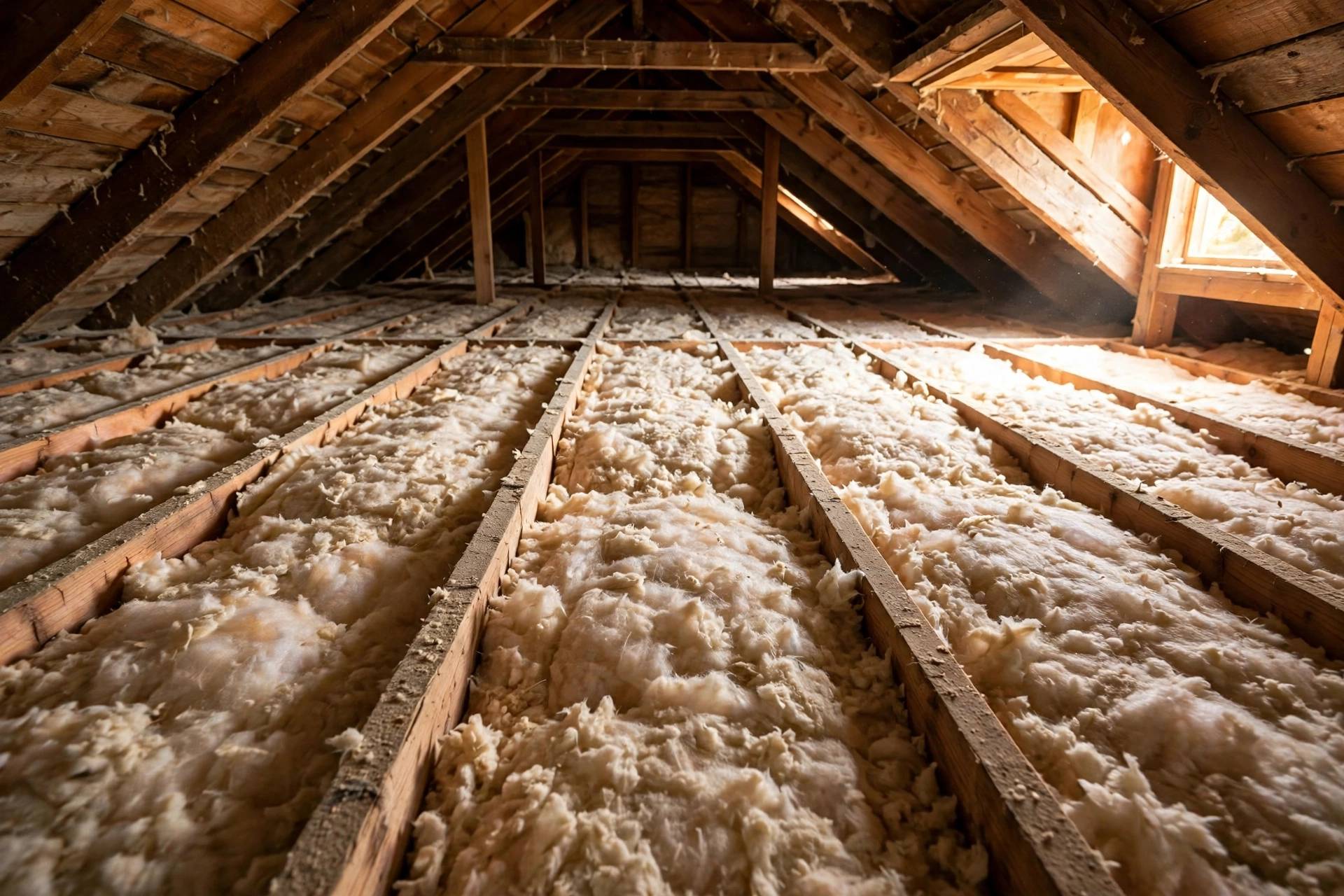
The material you choose moves attic insulation cost more than any other single choice. Blown-in insulation is loose material blown across the attic floor. Batt insulation comes in rolls or pre-cut blankets. Spray foam is applied as a liquid that expands and hardens. Each one suits a different attic, and the cheapest option is not always the best value.
| Material | Installed cost per sq ft | Typical use |
|---|---|---|
| Blown-in fiberglass | $1.00 to $2.50 | Topping up an existing attic floor |
| Blown-in cellulose | $1.10 to $2.80 | Higher R value per inch than fiberglass |
| Fiberglass batt | $0.80 to $2.60 | Open joists, knee walls, hatch covers |
| Open-cell spray foam | $2.60 to $4.40 at 6 inches | Roof deck, air sealing, conditioned attic |
| Closed-cell spray foam | $3.00 to $6.40 at 3 inches | Highest R per inch, vapor barrier |
For attic insulation cost planning, blown-in work is the usual baseline. A typical blown-in project runs $900 to $3,600, and national data from 2026 puts the average blown-in job at about $1,661, with most homeowners paying $987 to $2,335. Batt insulation sits in a similar band at $0.80 to $2.60 per square foot installed, though a tighter professional band of $1.50 to $2.00 per square foot appears in some guides. Spray foam insulation cost is a different category, covered in detail below, because it does a different job from floor insulation.
Blown-In vs Spray Foam: The Core Buyer Decision
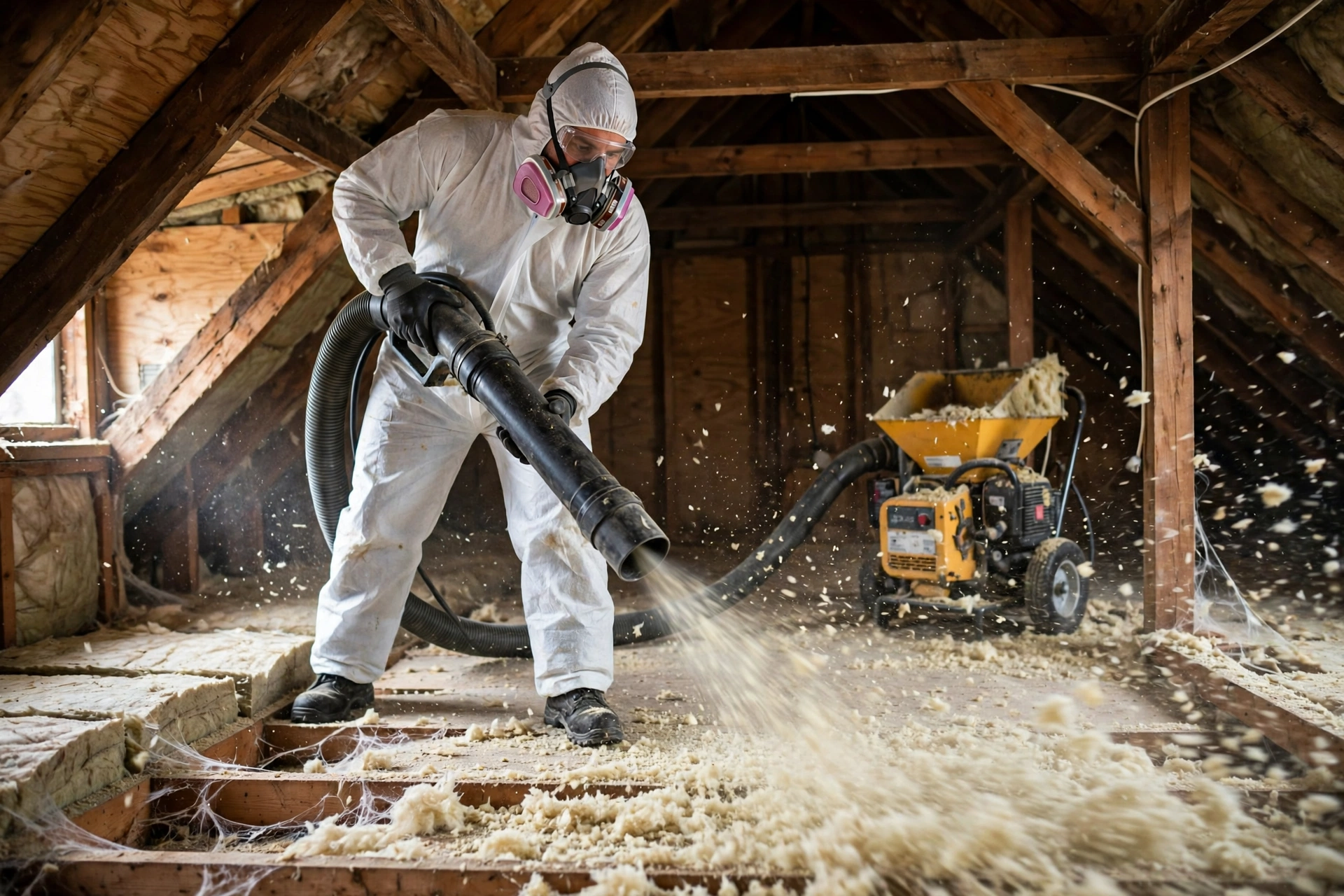
Blown-in vs spray foam is the decision that shapes attic insulation cost, comfort, and the finished attic itself. Blown-in insulation goes on the attic floor. It is the cheapest per square foot and the cheapest per unit of R value, it fills gaps and irregular areas well, and it is the best choice for topping up an attic that already has some insulation. It does not air seal on its own, so it needs a separate air sealing pass first.
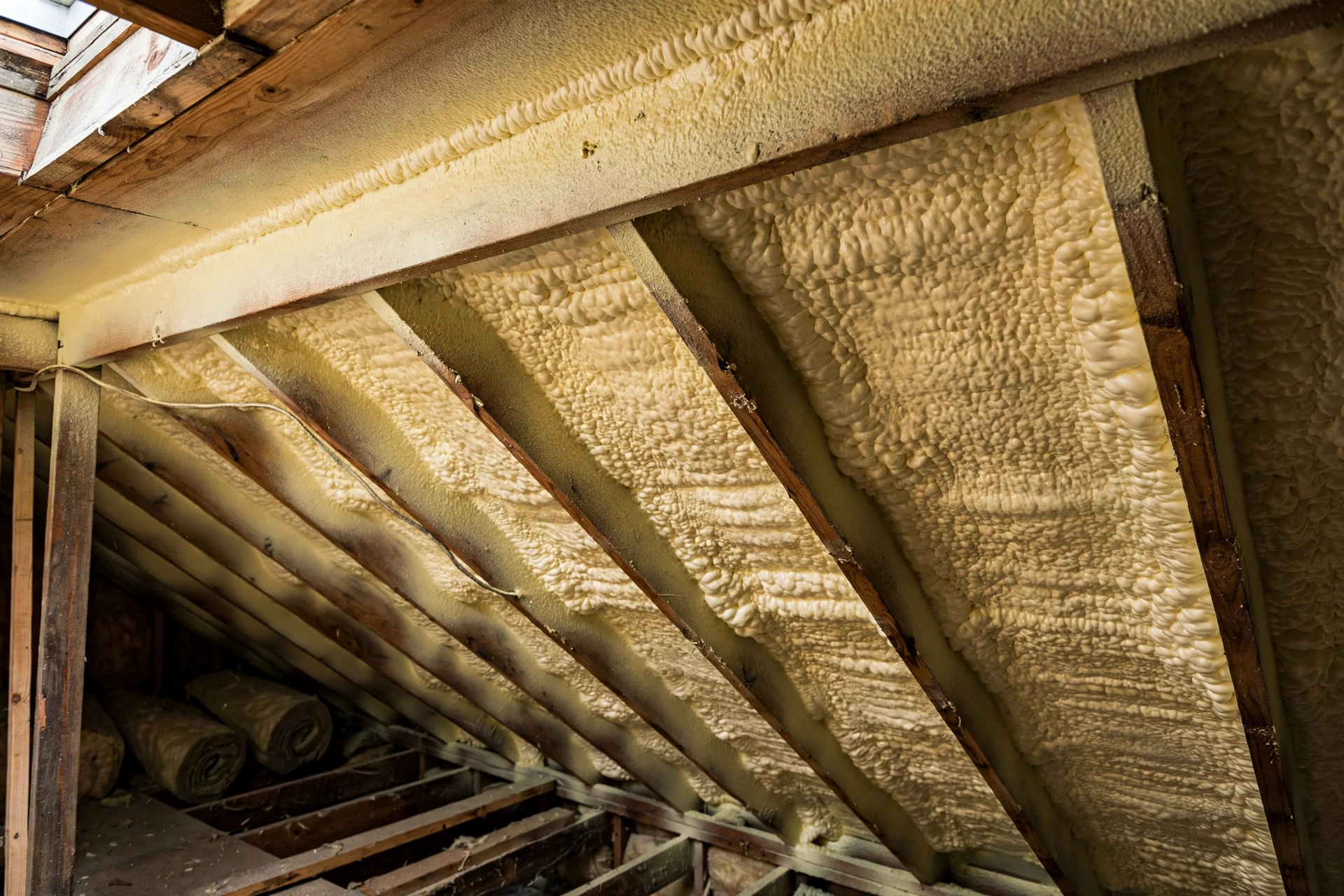
Spray foam goes on the underside of the roof deck instead. It air seals as it insulates, and it can turn the attic into a conditioned space, which matters if ducts or equipment live up there. Open-cell foam is cheaper and vapor permeable. Closed-cell foam is denser, gives about 6.5 R value per inch, and acts as a vapor barrier, but it costs much more at depth. That is why spray foam insulation cost should never be quoted as one flat number. Use $3 to $7 per square foot as the supporting band, then split it by foam type and depth, as the table above does.
Batts sit between the two on attic insulation cost, but they have a practical weakness. They leave gaps around wiring, pipes, and framing, so they suit open joists with few obstructions, hatch covers, and knee walls. They are also the easiest DIY option, which matters if you plan to do part of the job yourself.
Attic Insulation Cost by Attic Size
Attic size turns attic insulation cost per square foot into a budget you can actually plan around. Measure the attic floor area, not the living area, and remember that existing insulation depth changes how much new material you need.
| Attic floor area | Typical installed range |
|---|---|
| 500 sq ft | $750 to $1,500 |
| 800 sq ft | $1,200 to $2,400 |
| 1,000 sq ft | $1,500 to $3,000 |
| 1,200 sq ft | $1,800 to $3,600 |
| 1,500 sq ft | $2,250 to $4,500 |
| 2,000 sq ft | $3,000 to $6,000 |
That is why attic insulation cost should always be quoted per square foot of attic floor, with the material and depth named. Small attics face one extra problem. Some companies will not blow insulation for less than $1,500 to $2,000, so a small job can cost more per square foot than a large one. If your attic is small, ask about the minimum charge up front, and consider bundling the work with air sealing or a hatch cover upgrade in the same visit.
The 1,000 Square Foot Attic to R-38
A 1,000 square foot attic brought up to R-38 is the most useful worked example for attic insulation cost. As a central planning figure, budget $1,500 to $2,500 for a standard job. The wider fresh range is $1,000 to $3,000, because existing depth and air sealing move the number. Blown-in work to R-38 alone lands around $1,000 to $2,200 turnkey in tighter guides, with cellulose at $1,100 to $2,000 and fiberglass at $1,000 to $1,900 for the same attic.
The upgrade math is worth knowing before the crew leaves. Going from R-30 to R-49 in blown-in cellulose on a 1,000 square foot attic costs only about $140 to $210 more in material, for about 25 percent more energy savings than R-30. The material is trivial next to labor and setup, so topping up to the higher target while the crew is already there is usually worth it.
What R-Value Do You Need?
Attic insulation cost only makes sense against a target, and the target is R-value, a measure of resistance to heat flow. The US Department of Energy recommends R-38 to R-60 for attics in most climate zones, and the US Department of Energy Energy Saver guide explains insulation and energy saving guidance in plain terms.
| Climate zone | Recommended attic R-value |
|---|---|
| Zones 1 to 2, hot South | R-30 to R-38 |
| Zones 3 to 4, warm to mixed | R-38 to R-49 |
| Zones 5 to 8, cool to cold North and mountain | R-49 to R-60 |
Knowing the target keeps attic insulation cost honest, because a thin job quoted cheaply is not the same product as a full depth job. Depth makes the target concrete. R-38 is about 13.5 inches of blown fiberglass or about 10.4 inches of settled cellulose. R-60 is about 20.5 inches of fiberglass or about 16.1 inches of cellulose. Brands differ, so follow the chart on the bag. One ventilation warning matters as much as depth: do not block soffit vents with new insulation. Install baffles at the eaves so air flows from soffits to ridge vents, or trapped moisture will feed ice dams.
Air Sealing First: The Step Contractors Skip
Air sealing is the highest return work in most attic projects, and it is also the step most often skipped. Attic insulation cost should include $300 to $1,500 for air sealing as a line item, done before any new insulation goes down, because sealing happens at the ceiling plane the new material will bury. A blower-door test alone costs $300 to $500, and a full energy audit costs $600 to $900.
A quote that omits air sealing will understate attic insulation cost, then charge it later as an extra. Sealing means closing gaps around light fixtures, plumbing and wiring penetrations, chimney chases, and the attic hatch, so conditioned air stops leaking into the attic. Insulation without sealing is like a thick coat with the zipper open. It slows heat flow but does not stop air flow, and air flow carries moisture with it. Ask for air sealing in writing, with the test result if one was run.
Will Insulation Shrink Your AC Size?
Sequence is the distinctive angle in attic insulation cost planning. Audit and air seal first, insulate to the climate zone target second, then run a Manual J load calculation and size equipment to the improved house third. A thorough attic job can shrink the required air conditioner by half a ton to a full ton, according to contractor reports. That is a possibility, not a guarantee, but when a replacement is already planned, the insulation can pay for itself in avoided equipment cost before the first utility bill.
Do not run the sequence backward. A new oversized system installed first, then insulation later, leaves a system that short-cycles in the improved house, and part of the insulation saving evaporates into poor part-load performance. If the replacement cannot wait, have the contractor run the Manual J against the planned insulation level, or choose variable-capacity equipment that tolerates a range of loads. Our guide to AC unit cost shows how tonnage and efficiency drive equipment prices, and our HVAC replacement cost guide covers full system pricing, so insulate before you upsize the system.
Add-Ons and Hidden Costs
The headline attic insulation cost rarely covers everything. Old or contaminated insulation removal adds $1.00 to $2.00 per square foot extra, and some guides quote $1.50 to $3.00. Damaged ductwork, a leaky roof, or knob and tube wiring must be fixed before insulation goes in, not after. A new hatch cover, baffles, and damming around the hatch are small lines that are easy to miss in a verbal quote.
Fall timing matters too. Attic work is a classic pre-winter job, and scheduling it with winter preparation can save a second visit. Our guide to cost to winterize a house covers the wider seasonal checklist, and insulation belongs near the top of it.
DIY vs Pro, and What You Actually Save
DIY blown-in insulation costs $0.35 to $1.50 per square foot, or $500 to $1,200 on average, with blower rental at $100 to $200 per day, sometimes free with a large bag purchase. It is a two person job, and it suits a simple, open attic floor with good access. It does not suit a low, obstructed attic, a roof deck foam job, or any attic with old wiring, mold, or pest contamination.
When you compare DIY and pro attic insulation cost, count your own time, rental, and safety gear, not just bags of material. Savings should be framed as a range, never a guarantee. One 2026 guide quotes 12 percent heating and cooling savings on a $2,400 annual bill as about $290 a year, a 7 to 10 year payback before incentives. Your bill, climate, and current insulation depth move that number a lot. Choosing ENERGY STAR certified products is a simple way to filter for efficiency without studying spec sheets for every brand, and checking DSIRE for state and utility rebates is worth doing before you sign, since no federal credit should be counted for a 2026 install.
Frequently Asked Questions
How much does attic insulation cost?
A typical professional project costs $1,500 to $3,500. The national average is about $1,800, with most projects between $1,000 and $2,700, and large or spray foam jobs reaching $6,800 or more.
What is the blown-in insulation cost?
Blown-in insulation cost runs $1.00 to $2.80 per square foot installed. Fiberglass runs $1.00 to $2.50 and cellulose runs $1.10 to $2.80, with cellulose giving more R value per inch.
What is the batt insulation cost?
Batt insulation cost runs $0.80 to $2.60 per square foot installed. Professional fiberglass batt work often lands at $1.50 to $2.00, while DIY batt material runs $0.75 to $1.00.
What is the spray foam insulation cost?
Spray foam insulation cost runs $3 to $7 per square foot as a supporting band. Open-cell foam runs about $2.60 to $4.40 at 6 inches, and closed-cell foam runs about $3.00 to $6.40 at 3 inches, with some guides quoting closed-cell at $4.00 to $8.00.
What is the attic insulation cost per square foot?
Attic insulation cost per square foot depends on material: blown-in $1.00 to $2.80, batt $0.80 to $2.60, and spray foam $3 to $7. Air sealing, removal, and small-job minimums sit on top of those bands.
What is the R-value do I need in my attic?
Most US homes need R-38 to R-60. Hot southern zones need R-30 to R-38, warm to mixed zones need R-38 to R-49, and cool to cold northern zones need R-49 to R-60.
Should I air seal before insulating?
Yes, always. Air sealing costs $300 to $1,500 and must happen before new insulation buries the ceiling plane. Insulation without sealing slows heat flow but does not stop air leaks.
Will attic insulation shrink my AC size?
It can, by half a ton to a full ton, if you insulate first and then run a Manual J calculation. Insulating after an oversized system is installed wastes part of the saving, so sequence the work in the right order.
Attic insulation cost is one of the few home projects where the cheapest quote is often the most expensive mistake. Price the material, the depth, the air sealing, and the R-value target together, get 3 local quotes on the same scope, and choose the clearest quote, not just the lowest number.