Epoxy Basement Floor Cost 2026
If you are wondering what the epoxy basement floor cost looks like in 2026, here is the short answer: most professionally installed jobs run $3 to $12 per square foot, with a typical basement landing between $2,000 and $6,500 all in. That covers vapor testing, prep, the coating system, and a topcoat on a properly dry slab.
Covering the floor upstairs instead? Our carpet installation cost guide covers the soft flooring route room by room.
That epoxy basement floor cost range is wider than a garage quote for one reason: moisture. A basement slab sits below grade, it is often damp, and almost every job needs a moisture barrier that a garage floor skips entirely. Once you factor in vapor testing, prep, and the coating system itself, the numbers land where the market says they should.
This guide breaks down every piece of the epoxy basement floor cost puzzle: pricing by basement size, the epoxy systems pros actually install, the moisture testing you should never skip, what a professional job includes line by line, and where DIY kits make sense and where they fail. Every figure is a realistic 2026 US market estimate, and as always, getting 3 local quotes from concrete coating contractors is the surest way to pin down your number. Read it before you collect quotes and the epoxy basement floor cost on each bid will make sense line by line.
Old flooring coming up first? Our carpet removal cost guide shows what tear-out and disposal run before the new floor goes down.
How Much Does an Epoxy Basement Floor Cost?
For planning purposes, budget around $2,522 per project, which is Angi’s 2026 national average, with the typical range running $750 to $5,800. Per square foot, expect $3 to $12 installed for most epoxy basement floor cost estimates, and note that small basements cost more per foot because contractors carry a $1,000 to $1,500 minimum service charge.
| Basement size | Typical total (flake system) |
|---|---|
| 500 sq ft | $2,000 to $4,000 |
| 750 sq ft | $3,000 to $6,000 |
| 1,000 sq ft | $4,000 to $8,000 |
| 1,500 sq ft | $6,000 to $12,000 |
For context against other basement floors, polished concrete runs $3 to $8 per square foot and lets vapor pass through, so it never blisters, but it will not hide slab flaws the way a flake broadcast does. Luxury vinyl plank runs $4 to $11 installed, is waterproof and warmer underfoot, but needs a flat subfloor and its own moisture barrier. Ceramic tile runs $10 to $40 per square foot installed, which makes epoxy the middle ground: tougher than paint, cheaper than tile, and more seamless than plank. That middle ground is exactly why the epoxy basement floor cost of a flake system wins so many basement projects.
These totals assume a standard full-flake system at $4 to $8 per square foot. Metallic runs roughly 1.5 to 2 times that, so a 1,000 square foot metallic basement lands near $7,000 to $12,000. Older slabs with heavy cracking may also need resurfacing at $3 to $7 per square foot, or concrete repairs budgeted between $1,000 and $5,000, before any coating goes down.
Epoxy Types and What They Cost
The system you pick is the biggest lever on epoxy basement floor cost. Water-based epoxy at $2 to $4 per square foot is a budget refresh for light-use spaces, while a solid-color 100 percent solids epoxy at $3 to $6 per square foot is the workhorse for both garages and basements.
| System | Installed price per sq ft |
|---|---|
| Water-based epoxy (kit grade) | $2 to $4 |
| Solid-color 100% solids epoxy | $3 to $6 |
| Full-flake (chip) system | $4 to $8 |
| Thicker-build 100% solids | $5 to $10 |
| Quartz epoxy | $7 to $12 |
| Metallic epoxy | $6 to $12 |
| Polyaspartic (flake or solid) | $5 to $10 |
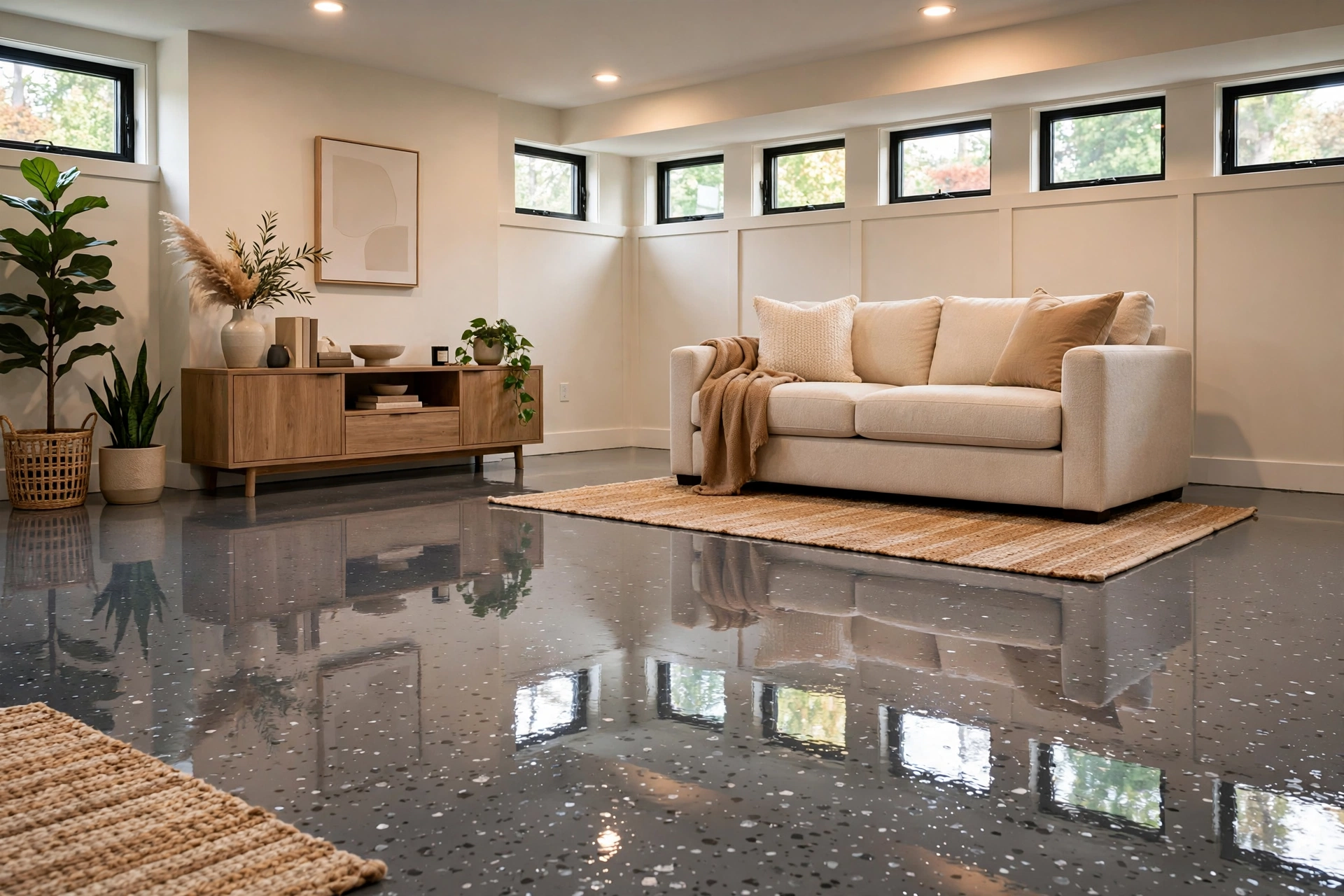
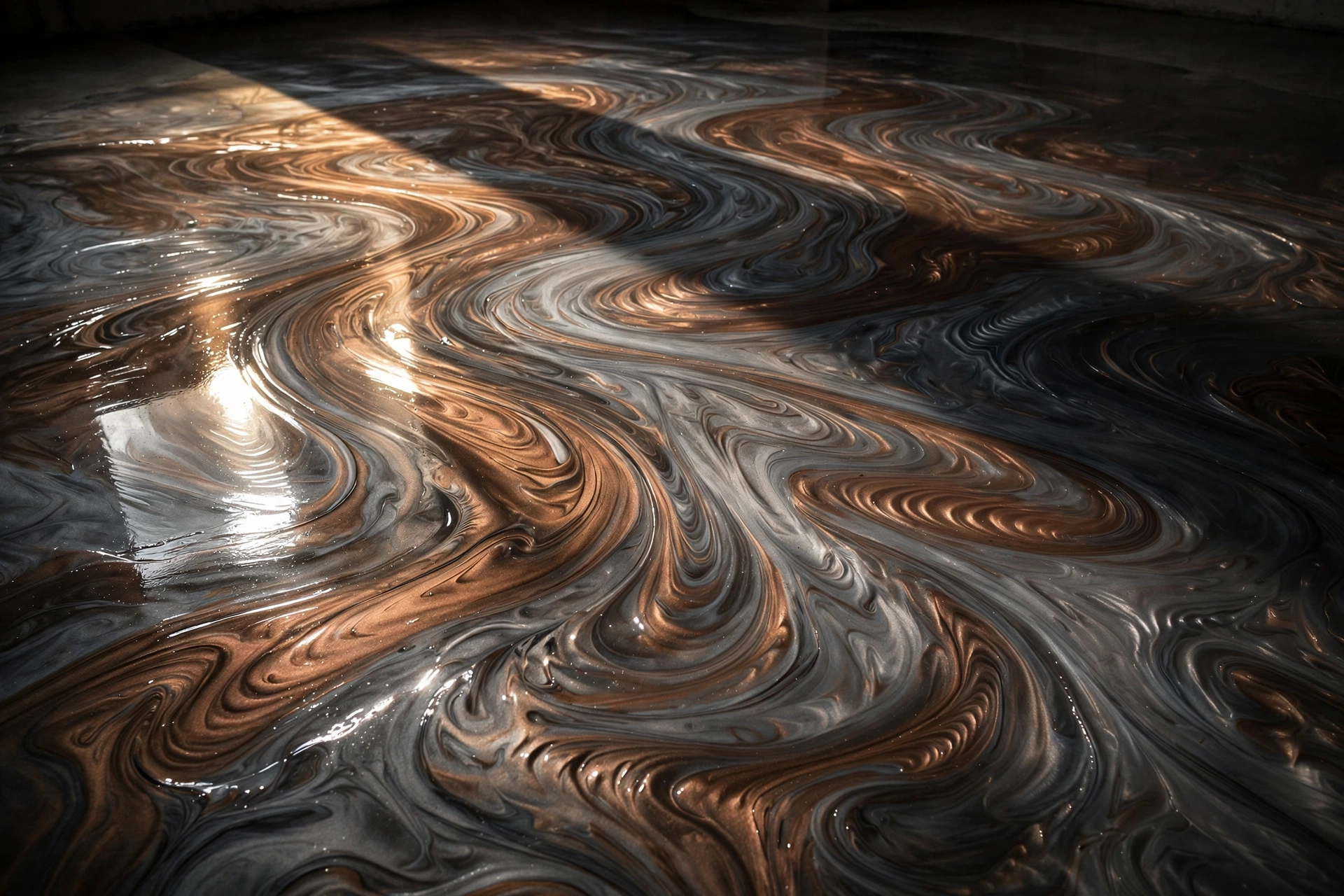
Full-flake is the most popular residential system at $4 to $8 per square foot because the broadcast chips hide slab imperfections and add traction underfoot. Metallic epoxy costs $6 to $12 per square foot and looks like a showroom floor, but it shows dust and scratches more than flake, so it is the showpiece choice, not the practical one. Quartz epoxy at $7 to $12 per square foot adds serious grip for commercial-feel spaces, while polyaspartic at $5 to $10 cures fast and resists UV, which matters less in a windowless basement. Most homeowners comparing these systems find the epoxy basement floor cost of flake the easiest to justify: durable, attractive, and mid-priced.
The Moisture Problem Every Basement Owner Must Solve First
Here is where basement jobs separate from garage jobs. If a calcium chloride test reads above 3 to 4 pounds per 24 hours, you need a moisture-barrier primer before the standard coating, which adds $1 to $2.50 per square foot to the epoxy basement floor cost. Skip it and trapped vapor blisters the coating off within months, sometimes within weeks.
Epoxy cannot seal active water entry. If your slab has ongoing seepage, fix drainage first: a sump pump runs $1,200 to $2,500, an interior French drain runs $60 to $120 per linear foot, and full waterproofing systems run $3,000 to $15,000 or more. The EPA guidance on moisture and mold explains why keeping the slab dry matters far beyond cosmetics.
Test first with the plastic sheet method: tape plastic to the slab for 24 hours, and if condensation forms underneath, the slab is too wet to coat. An honest contractor will fail your floor at this stage, and that is exactly the contractor you want. Roll epoxy over a wet slab and your entire epoxy basement floor cost becomes a removal bill a year later.
What Is Included in a Pro Install
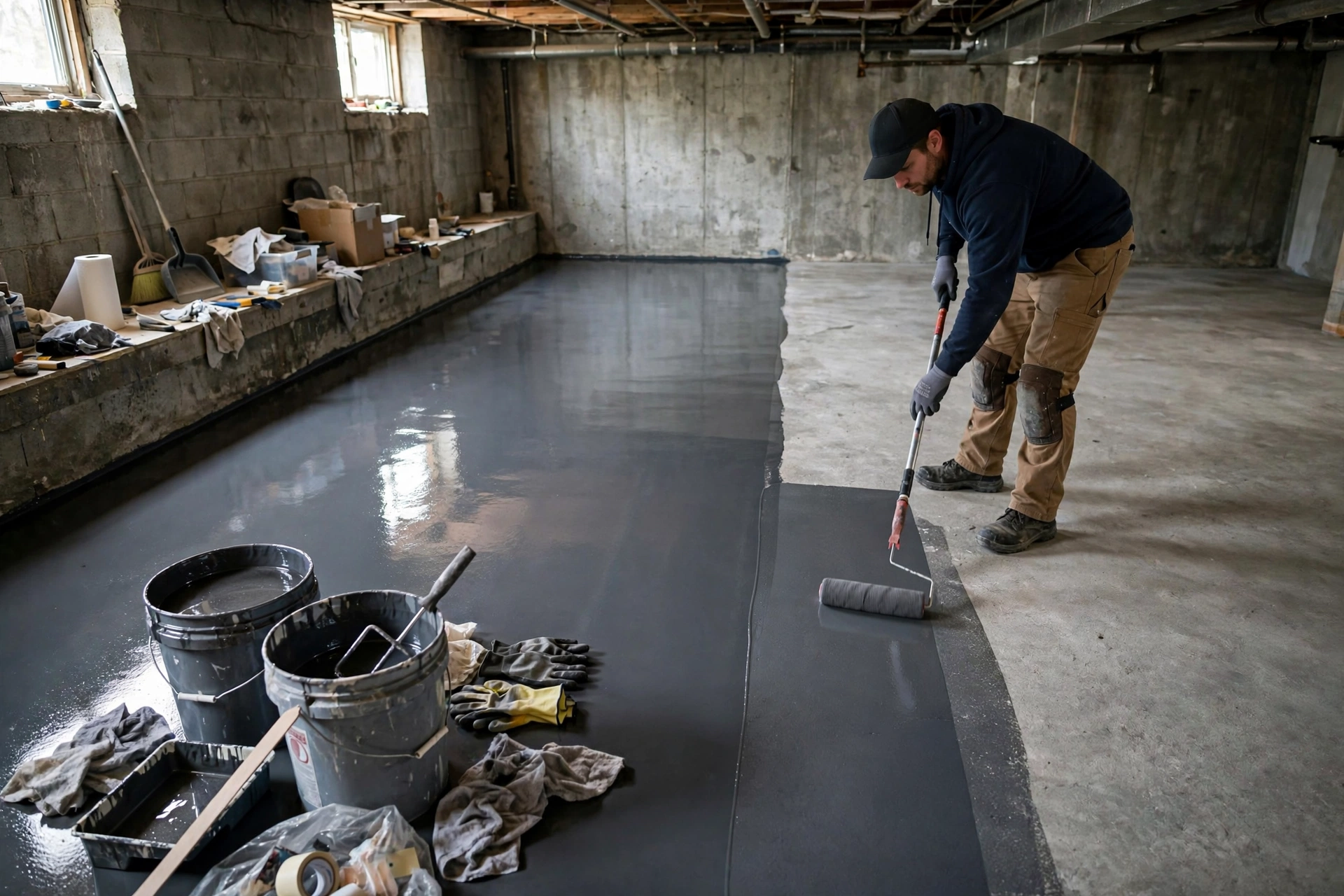
A professional epoxy basement floor cost is mostly labor and prep, not the epoxy itself. Diamond grinding the slab runs $0.75 to $1.50 per square foot, and prep alone is 30 to 40 percent of the total on existing concrete. Epoxy applied to smooth, dirty concrete delaminates within months, so grinding is the non-negotiable foundation of the job.
If your basement already has old paint or a failed coating, removal by grinding adds $1 to $3 per square foot, and a fully failed coating that must come off runs $1 to $8 per square foot before the new system goes down. A realistic epoxy basement floor cost quote should call out prep as its own line item. If a bid lumps everything into one per-foot number, ask what the prep covers, because skipped grinding is the most common reason a floor fails in year two.
After grinding comes crack repair at $50 to $300 flat per project, or $1 to $3 per linear foot. Then the system: a primer, a base color coat, an optional flake broadcast, and a clear topcoat that adds $0.50 to $1.00 per square foot, with an anti-slip additive at $0.25 to $0.50 per square foot where traction matters. Labor runs 50 to 70 percent of the total, materials $1 to $6 per square foot.
The standard timeline is 2 to 3 days on the floor, walkable in 24 to 72 hours, and if a car ever parks on it, 5 to 7 days before vehicles. When you itemize it this way, the epoxy basement floor cost stops looking like a single number and starts reading like the multi-step trade job it actually is.
Epoxy Garage Floor Cost: How Basements Compare
Readers cross-shop these two jobs constantly, so here is the comparison. The average epoxy garage floor cost for a 2-car garage runs $1,200 to $4,500 installed, and a flake garage floor specifically lands at $5 to $8 per square foot. Basements run higher for one structural reason: the slab is below grade, often damp, and nearly always needs the moisture-barrier add-on that garages skip.
The typical basement runs $2,000 to $6,500 against that garage band because moisture control, crack repair on older slabs, and larger continuous pours push the epoxy basement floor cost up. Think of the garage price as the floor and the basement as the floor plus the below-grade surcharge.
DIY Epoxy Kits vs Pro Installation
A Rust-Oleum EpoxyShield kit runs about $185 and covers up to 500 square feet, so a 2-car garage goes down for $150 to $600 in materials. That sounds like a bargain next to a pro quote, until you look at what you are actually getting. A DIY coat lands at 3 to 10 mils thick against a professional 20 to 40 plus mils, and a DIY epoxy basement floor cost of a few hundred dollars buys 2 to 5 years of life against a pro’s 10 to 20.
The failure statistics are blunt: 30 to 50 percent of DIY epoxy applications peel within the first two years, almost always because the prep was acid etching instead of diamond grinding. Pro-grade kits at $300 to $700 per kit close some of the gap but cannot fix skipped prep. DIY makes sense for a low-traffic basement you plan to redo anyway. For a finished living space, pro prep and thickness win, and the pro epoxy basement floor cost pays for itself the first time you do not have to redo the floor.
A full DIY basement with grinder rental, crack filler, and supplies typically runs $1.50 to $4.50 per square foot all in, and pro-grade kits from companies like ArmorPoxy or Epoxy-Coat run $300 to $700 per kit, which closes some of the durability gap but cannot fix skipped prep. If you go the DIY route, rent a real diamond grinder, run the plastic sheet moisture test first, and never coat in a sealed basement with no airflow.
One more DIY consideration is curing fumes. Epoxy off-gasses while it cures, and a basement has limited ventilation, so follow the EPA indoor air quality guidance on ventilation, keep the house aired out during the cure, and keep kids and pets off the floor until it is fully cured. That caution applies to pro installs too, just for fewer days.
How Long Does an Epoxy Basement Floor Last?
A professionally installed epoxy floor lasts 10 to 20 years, and most need a topcoat refresh around year 10 to 15 at $0.50 to $1.00 per square foot. Water-based and kit epoxies last 3 to 5 years before needing a new coat. Maintenance is simple: sweep and mop regularly, clean spills quickly, and recoat the top layer when wear appears rather than waiting for failure. Pro jobs typically carry 5 to 15 year warranties. Over a 20-year span, that longevity is what makes a professional epoxy basement floor cost cheaper per year than the cheapest DIY job you redo three times.
Watch for the warning signs that a topcoat is wearing: dull spots in traffic lanes, small chips at the edges, or a loss of gloss that mopping no longer fixes. A timely refresh is the cheapest money in this trade. Compare that against skipping it and facing a full grind-off at $1 to $8 per square foot plus a brand-new system, and the maintenance case writes itself. Disciplined upkeep is how a smart epoxy basement floor cost stretches across a full 20 years of service.
When failure does happen, old-coating removal by grinding runs $1 to $8 per square foot before the new system goes down, which is why getting the install right the first time matters more than getting it cheap. Budget for the topcoat refresh at year 12 or so and your epoxy basement floor cost per year of service stays remarkably low.
Frequently Asked Questions
How much does it cost to epoxy a basement floor?
About $3 to $12 per square foot installed, with most basements landing $2,000 to $6,500 once a flake system and moisture barrier are included. When homeowners ask how much does epoxy flooring cost in a basement versus a garage, the honest answer is that the basement runs higher because of moisture control.
What is the epoxy floor cost per square foot for a basement?
The epoxy floor cost per square foot runs $3 to $12 installed depending on the system, with full-flake at $4 to $8 as the most common choice. Metallic and quartz systems sit at the top of the band. That band covers labor and materials for a pro job on a properly tested slab.
Does epoxy work on damp basement floors?
Only with a moisture-barrier primer, which adds $1 to $2.50 per square foot to the basement floor epoxy cost. Active water entry must be fixed with drainage first, since epoxy alone cannot seal it. Skipping the vapor test is the single most common cause of failed basement floors.
How long does basement epoxy last?
Ten to 20 years for a professional install, 3 to 5 years for water-based DIY kits. Plan a topcoat refresh around year 10 to 15. Sweep and mop for maintenance, and recoat before wear reaches the base coat, which keeps your epoxy basement floor cost spread thin across decades of service.
Can I epoxy my basement myself?
Yes, a kit runs $150 to $600 for a 2-car garage-sized space, but pro systems are 2 to 4 times thicker, 20 to 40 plus mils against 3 to 10, and 30 to 50 percent of DIY jobs peel within two years from poor prep. If the basement is a finished living space, the pro epoxy basement floor cost is the safer money.
Is metallic epoxy worth it in a basement?
Metallic is the showpiece option at $6 to $12 per square foot, but it shows dust and scratches more than flake. For a living-space basement, flake at $4 to $8 per square foot is the practical pick that keeps the epoxy basement floor cost reasonable while still looking finished.