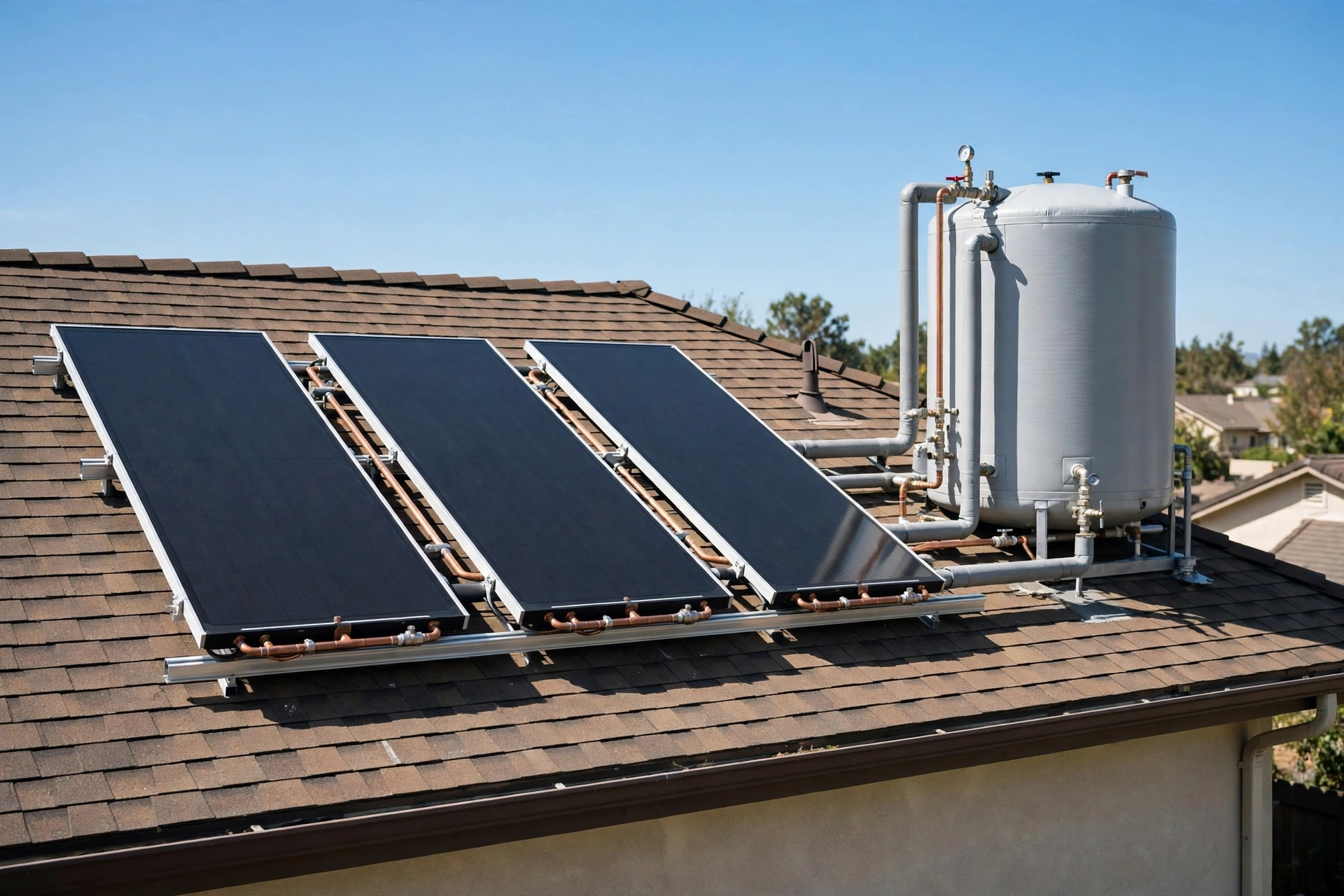
Solar Water Heater Cost 2026
A solar water heater costs about $3,700 installed on average in 2026, with most homeowners paying $1,800 to $5,700. Equipment runs $1,500 to $5,000 and professional installation adds $1,000 to $2,500. One big 2026 change: the 30% federal tax credit expired, so check state and utility rebates instead. Figures below reflect 2026 national averages from contractor pricing data; your local quote may vary, so get 3 local quotes before committing.
Water heating eats 20 to 25 percent of the average home’s energy use, which makes the roof above your head a tempting power source. A solar water heater will not eliminate your water heating bill, but it can cut it by more than half for 15 to 20 years. Here is what these systems cost in 2026, how the types compare, and whether the math works without the old federal credit.
How much does a solar water heater cost in 2026?
Angi 2026 data puts the average installed cost at about $3,700. Most homeowners pay $1,800 to $5,700 for a standard residential system. The full market range runs $2,500 to $9,000, with premium or complex installs reaching $10,000 to $12,000. All figures here are pre-incentive.
| System type | Typical cost (2026 estimate) |
|---|---|
| Passive (ICS or thermosiphon) | $1,800 to $4,800 |
| Active direct circulation | $2,500 to $5,500 |
| Active indirect (glycol, freeze protected) | $4,000 to $8,000 |
| Flat-plate collector system | $3,000 to $8,000 |
| Evacuated-tube collector system | $5,000 to $10,000 |
Solar water heater types explained
Passive systems ($1,800 to $4,800)
Passive systems have no pumps, no controllers, no sensors: water moves by physics. Integral Collector Storage (ICS) units run $2,500 to $5,000 installed, and thermosiphon systems (tank mounted above the collector) run $3,000 to $5,500. They are simpler, cheaper, and have almost nothing to break, but they only suit warm climates and need careful freeze planning.
Active systems ($2,500 to $8,000)
Active systems use pumps and controllers to circulate water or heat-transfer fluid. Direct circulation systems pump household water through the collectors: $2,500 to $5,500, cheapest of the active options, but only for areas that rarely freeze. Indirect circulation systems run a glycol loop through a heat exchanger: $4,000 to $8,000, and the standard choice for cold climates since the glycol cannot freeze and burst the collectors.
Flat-plate vs evacuated-tube collectors
Flat-plate collectors cost less ($550 to $750 each for 20 to 22 sq ft panels) and suit warm, sunny climates. Evacuated-tube collectors perform better in cold or cloudy weather but cost more ($500 to $1,550 by tube count) and the glass tubes are more fragile. In warm climates, choose flat plate and save $1,000 to $2,000.
What size system do you need?
Standard DOE sizing guidance: about 20 square feet of collector per 2 people, and about 1.5 gallons of storage per square foot of collector.
| Household | Tank size | Collector area | Typical cost (2026 estimate) |
|---|---|---|---|
| 2 people | 50 gal | 40 sq ft | $2,000 to $3,500 |
| 3 to 4 people | 80 gal | 60 sq ft | $3,500 to $5,500 |
| 5 to 6 people | 120 gal | 80 sq ft | $5,000 to $8,000 |
A family of 4 typically needs 2 to 3 collectors covering 48 to 72 square feet of roof. Size to your actual hot water use: oversizing wastes money without adding savings, and undersizing forces the backup heater to run constantly. The average US household uses roughly 64 gallons of hot water per day.
What affects the price
- Roof condition and orientation: South-facing with minimal shade is ideal; east or west works with an extra collector. Roof repairs, steep pitches, or difficult access add $500 to $1,500.
- Backup system: Every solar water heater needs electric or gas backup for cloudy stretches. A new backup tank adds $800 to $1,500 if the old one cannot be reused.
- Freeze protection: Indirect glycol or drainback designs add $500 to $1,500 in cold climates. Direct systems are cheapest but only suit areas that rarely freeze.
- Permits: Plumbing permits run $150 to $400; some jurisdictions require structural review for heavy roof-mounted tanks.
- Water quality: Hard water areas need more frequent tank flushing and may need a softener to protect the heat exchanger.
The 2026 tax credit situation
This is the big change for 2026: the 30% Residential Clean Energy Credit (Section 25D) ended for homeowner-owned systems placed in service after December 31, 2025. A system installed in 2026 gets zero federal credit. Many contractor websites still advertise 30 percent; that information is outdated. Only third-party-owned systems (leases) can still carry federal value.
State and utility rebates are still live and worth chasing: Florida utilities offer up to $400 to $500, Southwest Gas in Arizona offers up to $2,000 residential, Arizona has a 25% state income tax credit up to $1,000, and several states exempt solar equipment from sales tax. Search DSIRE and call your utility before signing: local rebates of $400 to $2,000 are common. Net cost after typical rebates runs roughly $2,500 to $7,500.
Savings, payback, and lifespan
Solar covers 50 to 80 percent of water heating energy, saving $300 to $1,000 per year on water heating bills according to DOE. Savings are highest when replacing an electric resistance tank. Without the federal credit, the payback period runs 6 to 10 years typically, or 4 to 6 years in sunny states with high electricity rates and local rebates.
The system lasts 15 to 20 years overall; collectors often reach 20 to 30 years while tanks need replacement sooner. That is roughly double a conventional tank’s 8 to 12 year life. Maintenance is light: $100 to $300 per year for an annual check, glycol replacement every 3 to 5 years, and tank flushing every 3 to 5 years in hard water areas.
Solar vs heat pump vs traditional tanks
| System | Installed cost | Annual operating cost | Lifespan |
|---|---|---|---|
| Solar water heater | $3,000 to $9,000 | $50 to $200 | 15 to 20 years |
| Heat pump water heater | $1,800 to $3,500 | $150 to $300 | 10 to 15 years |
| Electric tank | $875 to $1,750 | $400 to $600 | 8 to 12 years |
| Gas tank | $1,000 to $2,500 | $250 to $400 | 8 to 12 years |
| Gas tankless | $2,000 to $3,500 | $200 to $350 | 15 to 20 years |
Reality check: a heat pump water heater now delivers most of the savings at roughly half the installed cost of solar thermal, with no roof required. Solar thermal wins mainly where the roof and climate are ideal and local rebates are strong. If you are going bigger on solar, see our solar panel installation cost guide for whole-home solar pricing.
DIY vs pro
DIY kits run $750 to $3,500 for equipment; a realistic all-in DIY lands at $1,500 to $4,500 after plumbing parts, mounting hardware, and permits. DIY is viable for a simple passive ICS or thermosiphon kit in a warm climate with basic plumbing skills and an accessible roof. Go pro for active indirect systems with glycol, steep or old roofs, freeze protection design, or where code requires licensed plumbing. Pro install adds $1,000 to $2,500 but protects the roof warranty and ensures correct freeze protection. Either way, pull permits: unpermitted roof plumbing can void homeowners insurance claims for leaks.
How to save money on a solar water heater
- Get 3 itemized quotes. Prices vary widely by market for identical equipment.
- Size to actual hot water use. Oversizing adds cost without extra savings.
- Chase local rebates first. Search DSIRE and call your utility before signing; $400 to $2,000 rebates are common and stackable.
- Choose flat plate in warm climates. Saves $1,000 to $2,000 over evacuated tube with no real performance loss.
- Time it with a roof replacement. Shared scaffolding, flashing, and labor cut both projects’ costs.
- Reuse a working backup tank. It only runs on cloudy stretches, so a functioning old tank is fine.
- Price a heat pump water heater as the alternative. If your roof is shaded or unsuitable, it typically costs half as much installed for similar bill savings.
Frequently asked questions
How much does a solar water heater cost in 2026?
About $3,700 on average installed, with most homeowners paying $1,800 to $5,700. Complex or premium systems run $8,000 to $12,000.
Is the 30% federal tax credit still available in 2026?
No. It expired for homeowner-owned systems placed in service after December 31, 2025. Check state and utility rebates instead.
How much can I save per year?
$300 to $1,000 per year according to DOE, with solar covering 50% to 80% of water heating energy. Savings are biggest when replacing an electric tank.
How long do solar water heaters last?
15 to 20 years for the system overall; collectors often reach 20 to 30 years. Roughly double a conventional tank.
Do solar water heaters work in winter?
Yes. Evacuated-tube collectors handle cold and diffuse light best, though efficiency drops 20 to 40 percent in deep winter. Indirect glycol or drainback designs prevent freezing, and the backup heater covers cloudy stretches.
What maintenance do they need?
Minimal: an annual check for leaks and shading, glycol replacement every 3 to 5 years, and tank flushing every 3 to 5 years in hard water areas. Budget $100 to $300 per year.